Tshiṱirathedzhi tsha Paroli kha Rulete (Martingale yo Shandukiswaho)
Tshiṱirathedzhi tsha rulete tsha ParolitshiṱirathedzhiParoliNyengedzo ya bete nga murahu ha u kunda: andisani nga mbili nga murahu ha u kunda, thomani hafhu nga murahu ha u lozwa kana nga murahu ha u kunda luraru nga u tevhekana. I dovha ya vhidzwa: Martingale yo shandukiswaho.Vhalani zwoṱhe → tshi andisa bete kavhili nga murahu ha u kunda nahone tshi thoma hafhu nga murahu ha u lozwa kana nga murahu ha u kunda luraru nga u tevhekana.

It does not beat the wheel; it only changes how the losses arrive. A completed uncapped three-win cycle nets either +7 base units or −1. Winnings remain your money when you stake them again; expected loss depends on total turnover.
Tshimbilani kha sisiṱeme
U kunda hu ya tshiṱepe tshithihi phanḓa. Ndozwo, kana u kunda lwa vhuraru, zwi humela mathomoni.
Tshelede ya bete na mvelelo zwi kha dziyuniti dza bete ya mutheo.
Sisiṱeme ya rulete ya Paroli i shuma hani?
Bet one unittsheledeYunitiTshelede ya bete ya mutheo ine sisiṱeme kana mutambi a shuma ngayo. Nyengedzo dza bete dzi ṱalutshedzwa nga dziyuniti uri dzi shume kha tafula iṅwe na iṅwe.Vhalani zwoṱhe →. Win, and leave it all on the table: the next bet is two. Win again, and it is four. Win a third time, collect seven units of profit and go back to one. Lose at any point and you go back to one as well. That is the whole system. If the progressiontshiṱirathedzhiNyengedzo ya beteMulayo muṅwe na muṅwe une wa shandukisa tshelede ya bete u ya nga mvelelo dzo fhiraho. Nyengedzo nga murahu ha u lozwa i i engedza nga murahu ha ndozwo, nyengedzo nga murahu ha u kunda i i engedza nga murahu ha u kunda.Vhalani zwoṱhe → runs without clipping, a losing cycle ends one unit below its starting balance. A loss at the four-unit stage still gives back four units from the balance immediately before that spin. Three even-money wins in a row happen with probabilitymathematikiKhonadzeoKhonadzeo ya mvelelo, u bva kha 0 u ya kha 1 kana 0% u ya kha 100%. Nomboro nthihi: 1/37 = 2.70%.Vhalani zwoṱhe → (18/37)³ = 11.5%, about one cycle in nine.
Seshini i vha hani?
Completed cycles net −1 unit unless three consecutive wins produce +7. Over exactly 100 spins, an exact finite-state calculation gives about 38.43% net-profit probability and expected result −4.56 base units. This calculation starts at one unit, resets after a loss or three wins, and assumes enough funds with no stake clipping. BankrolltsheledeTshelede ya u tambaTshelede yoṱhe yo vhewaho thungo u itela u tamba. Ndangulo ya tshelede ya u tamba ndi u dzhia tsheo ya uri ni ḓo khakhisa nngafhani kha bete iṅwe na iṅwe na kha seshini iṅwe na iṅwe.Vhalani zwoṱhe → limits and interrupted cycles change the distribution.
- p10 −$500
- p25 −$500
- nomboro ya vhukati −$300
- p75 +$30
- p90 +$320
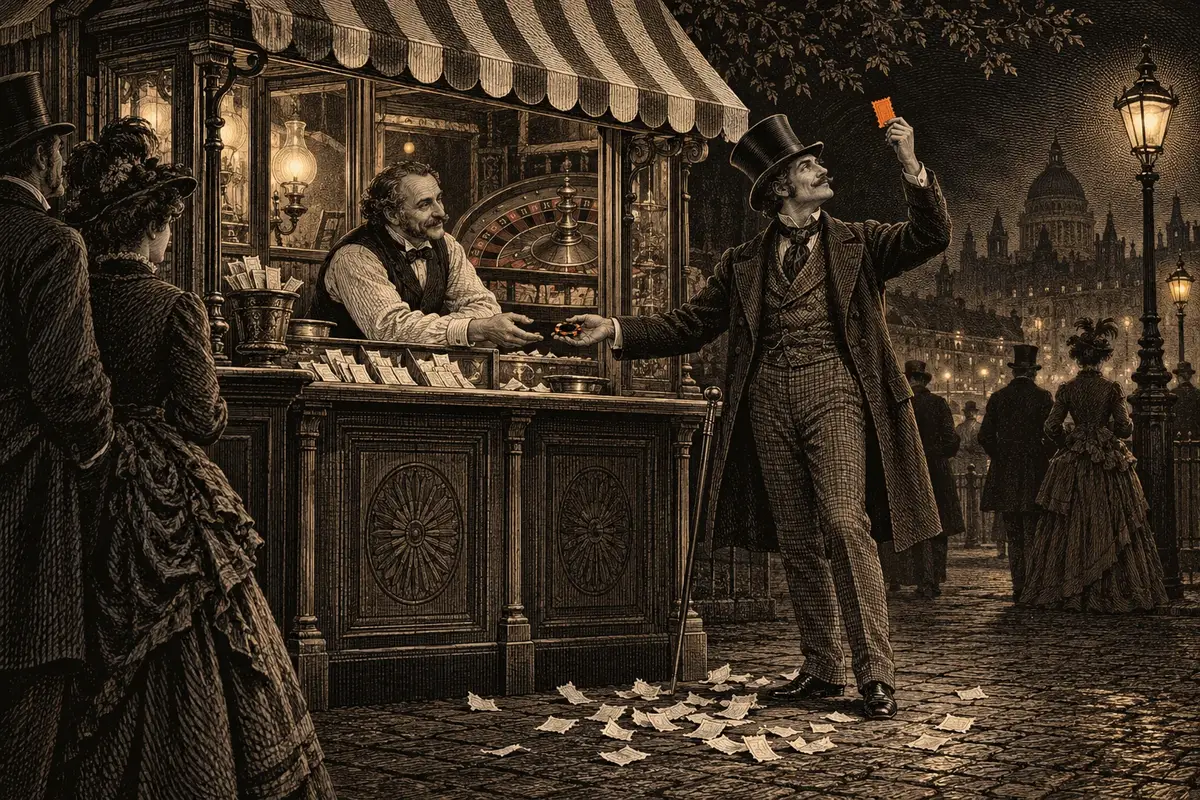
Naa sisiṱeme ya Paroli i a shuma?
It does not create a positive expected return. It changes both the distribution and turnovertsheledeTshelede yoṱhe ya dzibeteTshelede yoṱhe yo vhewaho kha seshini kana tshifhinga, hu tshi katelwa tshelede yo kundiwaho ye ya dovha ya vhewa. I dovha ya vhidzwa: handle, action.Vhalani zwoṱhe →, so expected session loss can change. Let p = 18/37. Win 7 with probability p³ = 0.115; lose 1 with probability 1 − p³ = 0.885. Expected result per cycle: 8p³ − 1 = −0.078909 units. Expected units wagered per cycle: 1 + 2p + 4p² = 1 + 0.973 + 0.947 = 2.92. Using unrounded values, −0.078909 / 2.919649 = −1/37. This is the standard single-zerovhiliZiroBuli ḽithihi ḽa muvhala wa tala ḽine ḽa sa farwe nga bete ya tshelede i linganaho, ya dazini kana ya kholomu; ndi tshisima tsha mbuelo ya khasino. Ḽi dovha ḽa vhidzwa: ziro nthihi, 0.Vhalani zwoṱhe → expected lossmathematikiNdozwo yo lavhelelwahoNdeme yo lavhelelwaho yo andiswa nga tshelede yoṱhe yo vhewaho; tshelede ine ya lozwiwa nga tshivhalo tsha vhukati kha seshini kana tshifhinga.Vhalani zwoṱhe → per unit wagered.
The tempting thought is that the pressed chipstsheledeTshipisiTshiga tshine tsha imela tshelede yo tiwaho, tshi vhewaho kha mapa wa tafula u vhea bete. Tshi dovha tsha vhidzwa: check.Vhalani zwoṱhe → are the casino’s money, so staking them costs nothing. They are yours from the moment they are paid, and each one put back on the table carries the same 2.70%.
Hu ḓo itea mini arali na lindela u kunda luṋa nga u tevhekana?
Consider an explicit four-win model: independent standard single-zero bets on redbeteTswukuBete ya tshelede i linganaho kha nomboro dza 18 tswuku. Nga Lufurantsi: rouge.Vhalani zwoṱhe →, one-unit base, no table limittafulaMukano wa tafulaBete ṱhukhu na khulwane dzine dza tendelwa. Mukano wa nṱha ndi wone u imisaho nyengedzo dza bete dza u andisa nga mbili.Vhalani zwoṱhe →, and stopping at the first completed four-win cycle or when the bankroll is exhausted. Four wins turn one unit into 16, a net gain of 15, with probability p = (18/37)⁴ ≈ 5.6012%. Each failed cycle loses one unit. With 15 starting units, the chance of completing a four-win cycle before ruin is 1 − (1 − p)¹⁵ ≈ 57.9%. That is higher than the 48.6% win probability of a single 15-unit red bet, but the rewards differ. Conditional on completing the cycle before ruin, the average net session gain is about 9.1 units after earlier failed cycles. Including failures, expected net result is about −1.07 units, versus −15/37 ≈ −0.41 for the single bet. A greater success probability does not imply a better expected return.
Naa zwi a ṱoḓea uri ni ima ngafhi?
Kha tshivhumbeo fhedzi. Paroli ya u swika u kunda luvhili (dzhiani 3) kana luṋa (dzhiani 15) i shandukisa uri ni kunda kangana na mbuelo, a i shandukisi mbuelo ya khasino. “Parlay” kha bete ya nomboro nthihi (u sia u kunda ha 35 kha 1 kha tafula) ndi muhumbulo wonoyo nga p = 1/37 na mbadelotsheledeMbadeloZwine bete yo kundaho ya humisa, zwi tshi ambiwa sa “X kha 1” nṱha ha tshelede ya bete i humiswaho.Vhalani zwoṱhe → ya 1,295 kha 1 kha u kunda luvhili nga u tevhekana, ndi ngazwo zwi tshi vha ngano kanzhi, hu si zwine vhathu vha zwi ita.
Ndi nnyi a i nangaho, nahone ndi ngani?
The rule limits a completed losing cycle to one base unit below its starting balance, provided stakes are not clipped. Repeated failed cycles can still exhaust a bankroll, and a loss after wins gives back accumulated gains. Under the stated fair-wheel model, expected loss is 1/37 of expected turnover; a session need not lose exactly that fraction.
Tshiedzisi · Paroli
Dziseshini dza 2,000 dza dzibete dza tshelede i linganaho dzi thoma nga tshelede ya u tamba ya $1,000.
Bete ya u thoma $10 · mukano wa tafula $500 · mimono ya 100 nga seshini
Mbudziso
I na tsireledzo nga nḓila ya uri a i koni u ḓisa ndozwo nthihi khulwane ya khombo. A i na mutengo wa fhasi: ndozwo yo lavhelelwaho nga yuniti nthihi yo vhewaho i a fana.
Fhethu hoṱhe ha u ima hu shuma nga nḓila i fanaho kha mathematiki. Luraru ndi zwa sialala ngauri mbuelo (dziyuniti dza 7) i pfala i tshi fanela u lindelwa nahone u kunda (11.5%) a hu fheli fulufhelo.
Zwa u sea
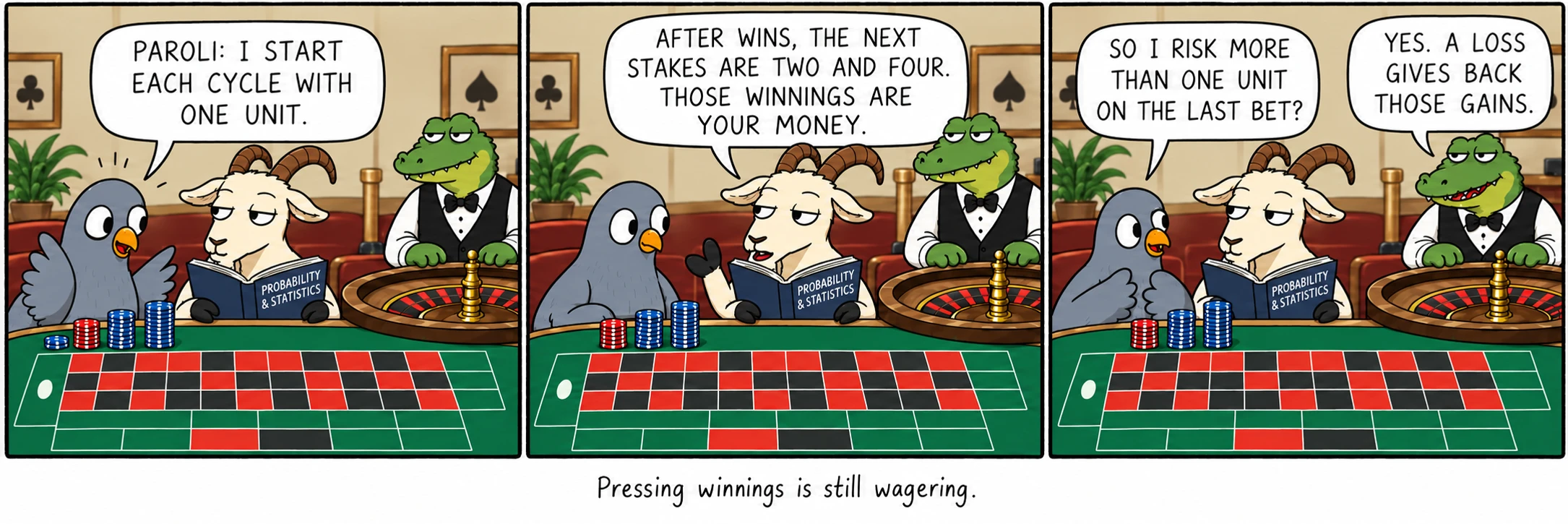
U vhea hafhu tshelede yo kundiwaho na hone ndi u vhea bete.
Zwiko
- RouletteDoc. Roulette strategies overview.
- Roulette77. Strategy description and examples.
- Ethier, S. N. The Doctrine of Chances: Probabilistic Aspects of Gambling.
- Epstein, R. A. The Theory of Gambling and Statistical Logic, 2nd ed.
- Taylor, D. G. Games, Gambling, and Probability: An Introduction to Mathematics, 2nd ed.