Ndozwo yo Lavhelelwaho
House edgemathematikiMbuelo ya khasinoTshipiḓa tsha tshelede ya bete iṅwe na iṅwe tshine khasino ya tshi vhulunga nga tshivhalo tsha vhukati: 2.70% kha rulete ya Yurophu.Vhalani zwoṱhe → times the amount wagered: how to calculate expected loss.

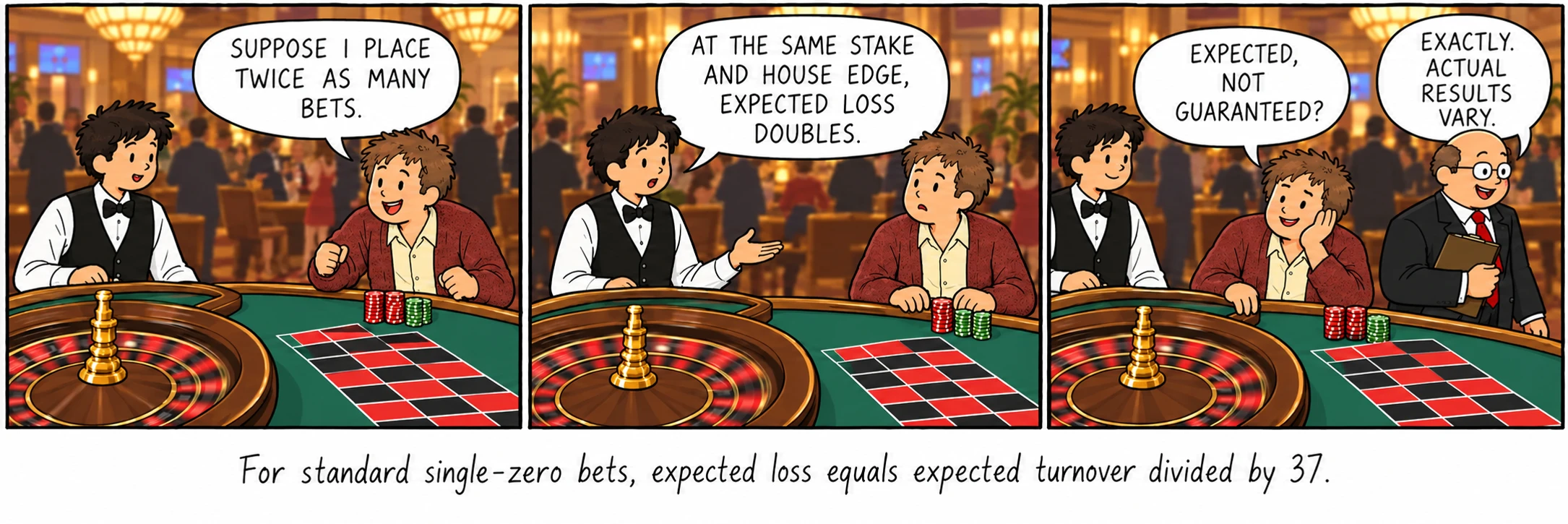
Ndozwo yo lavhelelwaho = tshelede yoṱhe yo vhewaho × 1/37. Tshelede ya bete ya $10, mimono ya 100: $1,000 yo vhewaho, ndozwo yo lavhelelwaho ya $27. Nyengedzo dza bete dzi vhea zwinzhi, ngauralo dzi lozwa zwinzhi.
Tshelede yoṱhe ya dzibete, hu si tshelede ya u tamba
Expected lossmathematikiNdozwo yo lavhelelwahoNdeme yo lavhelelwaho yo andiswa nga tshelede yoṱhe yo vhewaho; tshelede ine ya lozwiwa nga tshivhalo tsha vhukati kha seshini kana tshifhinga.Vhalani zwoṱhe → depends on how much passes across the table, not on how much you brought. Completing $2,000 of standard single-zerovhiliZiroBuli ḽithihi ḽa muvhala wa tala ḽine ḽa sa farwe nga bete ya tshelede i linganaho, ya dazini kana ya kholomu; ndi tshisima tsha mbuelo ya khasino. Ḽi dovha ḽa vhidzwa: ziro nthihi, 0.Vhalani zwoṱhe → bets gives an expected loss of $54.05. A $100 starting bankrolltsheledeTshelede ya u tambaTshelede yoṱhe yo vhewaho thungo u itela u tamba. Ndangulo ya tshelede ya u tamba ndi u dzhia tsheo ya uri ni ḓo khakhisa nngafhani kha bete iṅwe na iṅwe na kha seshini iṅwe na iṅwe.Vhalani zwoṱhe → might or might not last long enough to complete that turnovertsheledeTshelede yoṱhe ya dzibeteTshelede yoṱhe yo vhewaho kha seshini kana tshifhinga, hu tshi katelwa tshelede yo kundiwaho ye ya dovha ya vhewa. I dovha ya vhidzwa: handle, action.Vhalani zwoṱhe →. A single $10,000 bet on redbeteTswukuBete ya tshelede i linganaho kha nomboro dza 18 tswuku. Nga Lufurantsi: rouge.Vhalani zwoṱhe → has an expected loss of $270.27. These are averages, not deductions or limits on the actual loss.
Fomula
For a fixed schedule of standard single-zero bets, E[loss] = total stakes / 37. With stakes or stopping times that depend on earlier results, expected loss is expected turnover / 37, provided expected turnover is finite. The table shows fixed-stake examples, assuming all 100 spins are completed. ProgressiontshiṱirathedzhiNyengedzo ya beteMulayo muṅwe na muṅwe une wa shandukisa tshelede ya bete u ya nga mvelelo dzo fhiraho. Nyengedzo nga murahu ha u lozwa i i engedza nga murahu ha ndozwo, nyengedzo nga murahu ha u kunda i i engedza nga murahu ha u kunda.Vhalani zwoṱhe → averages require a specified bankroll, limit, stopping rule and simulation or calculation.
U ṱavhanya
Dzitafula dza tshifhinga tsha zwino dzi monisa mimono ya 40–60 nga awara, dzitafula dza khasino 30–50, dzitafula dza u ṱavhanya 90 kana u fhira, dzitafula dza RNG nga u ṱavhanya hune na kilika ngaho. Nga tshelede ya bete i fanaho, u ṱavhanya ndi tshithu tshihulwane tshithihi tshi shandukisaho ndozwo yo lavhelelwaho nga awara: u bva kha tafula ya khasino i tshimbilaho zwiṱuku u ya kha tafula ya RNG i tambiwaho nga mimono ya 200 nga awara zwi andisa mutengo wa madekwana lwa iṋa hu si na u shanduka ha tshikalo.
Kha ṅwaha
At 50 spins per hour, two hours per week and $10 per spin for 52 weeks, total turnover is $52,000. Expected loss is about $1,405 on standard single-zero bets, $703 on la partagemulayoLa partageMulayo wa Furantsi: musi ziro i tshi bva, hafu ya tshelede ya bete ya tshelede i linganaho i a humiswa. U fhungudza mbuelo ya khasino kha dzeneedzo dzibete nga hafu u swika kha 1.35%.Vhalani zwoṱhe → even-money betsbeteBete ya tshelede i linganahoTswuku/ntswu, i sa linganiho/i linganaho, nṱha/fhasi. Nomboro dza 18, i badela 1:1.Vhalani zwoṱhe →, or $2,737 on standard double-zero bets other than the five-number bet. These figures assume every scheduled bet is made. Fewer bets, smaller stakes or a lower edge reduce expected loss; actual results remain uncertain.
Mutambo u re na ndeme i fhiraho bannga iṅwe na iṅwe
The St. Petersburg game, posed by Nicolaus Bernoulli in 1713, tosses a coin until it lands heads and pays $2 if that takes one toss, $4 if two, $8 if three, doubling each time. Every possible length adds $1 to the expected valuemathematikiNdeme yo lavhelelwahoMvelelo ya vhukati nga bete nga tshifhinga tshilapfu. −1/37 ya tshelede ya bete kha bete iṅwe na iṅwe ya ḓuvha ḽiṅwe na ḽiṅwe ya Yurophu.Vhalani zwoṱhe →, so on paper the game is worth an infinite amount. No bank can pay infinite prizes, and once the prizes are capped at what the bank holds, the value collapses: with a bank of $1 million the game is worth about $21, with $1 billion about $31. The comparison with MartingaletshiṱirathedzhiMartingaleNyengedzo ya bete ine ya andisa bete nga mbili nga murahu ha u lozwa huṅwe na huṅwe. Vhonani khethekanyo ya Zwiṱirathedzhi u ḓivha zwine ya zwi ita na zwine ya sa zwi ite.Vhalani zwoṱhe → is the importance of limits: a theoretical doubling sequence can require stakes beyond any finite bankroll or table limittafulaMukano wa tafulaBete ṱhukhu na khulwane dzine dza tendelwa. Mukano wa nṱha ndi wone u imisaho nyengedzo dza bete dza u andisa nga mbili.Vhalani zwoṱhe →. That does not make the two games identical. A failed progression need not lose the entire bankroll, and a short session can finish ahead.

Ndozwo yo lavhelelwaho a si mvelelo
A single session can differ greatly from its expected loss. For 100 independent standard single-zero even-money bets at $10 each, the net result has a standard deviationmathematikiPhambuwo ya tshiṱandadiMudzi wa tshikwea wa vhariantsi; tshikhala tsha ḓuvha ḽiṅwe na ḽiṅwe vhukati ha mvelelo na ndeme yo lavhelelwaho.Vhalani zwoṱhe → of about $99.96 and an expected value of −$27.03. A winning session is possible. Expected loss describes the average across repeated sessions under those assumptions; it is neither a fee nor a limit on what one session can lose.
Fomula
Mbudziso
No fixed percentage is deducted from your buy-intafulaU renga zwipisiU shandukisa masheleni nga zwipisi tafulani. Zwi itwa vhukati ha mimono, tshelede i tshi vhewa kha mapa wa tafula nṱhani ha u ṋewa mukurupiye.Vhalani zwoṱhe →. For standard bets on a fair single-zero wheel, expected loss is about 2.70% of the amount wagered. Actual results vary. Re-betting winnings adds to the amount wagered.
With the same rules and number of bets, a smaller fixed stake lowers expected loss. The probabilitymathematikiKhonadzeoKhonadzeo ya mvelelo, u bva kha 0 u ya kha 1 kana 0% u ya kha 100%. Nomboro nthihi: 1/37 = 2.70%.Vhalani zwoṱhe → of reaching a profit target is a different question and also depends on bankroll, stake and stopping rules.
Dzikhasino dzi humbulela ndozwo yaṋu yo lavhelelwaho u bva kha bete ya vhukati na tshifhinga tsha u tamba nahone dzi humisa tshipiḓa tshayo sa zwilambo. Dzi khou humisa tshipiḓa tsha mutengo, a dzi ni ṋei mbuelo.
Zwa u sea
Tshelede yoṱhe ya dzibete × 1/37. Tshifhinga tshi kha fomula.
Zwiko
- Ethier, S. N. The Doctrine of Chances: Probabilistic Aspects of Gambling.
- Epstein, R. A. The Theory of Gambling and Statistical Logic, 2nd ed.
- Taylor, D. G. Games, Gambling, and Probability: An Introduction to Mathematics, 2nd ed.