Vha Eudaemons
Vhagudi vha fiziki, vhili ḽa khasino ḽo rengwaho nga tshelede ya tshanḓani, na khomphiyutha ṱhukhu ine ya nga ambarwa u ya kha tafula.

U bva nga 1976 u swika nga 1981 tshigwada tsha vhagudi vha fiziki ngei Santa Cruz tsho fhaṱa khomphiyutha dza didzhithala dze dza vhala tshifhinga tsha bola na tsha rotara nahone dza bula tshipiḓa tsha vhili musi dzibete dzi tshi kha ḓi vhewa. Ndingo dzavho dzo fulufhedzisa mbuelo ya 44% nahone seshini ya u thoma i lapfaho yo ṋea 25% nga u ṱoḓa. Zwishumiswa zwo dzula zwi tshi kundelwa, khomphiyutha ye ya vhewa ngomu ha tshienda yo kundwa nga phambano dza mudagasi nga 1981, nahone vho kunda dzidola dzi si gathi dza zwigidi.
Muhumbulo kha bara ya Las Vegas, 1975
Doyne Farmer recalls forming Eudaemonic Enterprises with Norman Packard and friends while in graduate school. They hoped roulette winnings would fund a science commune. Their idea depended on measuring the physical game, rather than changing stakes after wins or losses.
Vhili kha laborathori ya fiziki
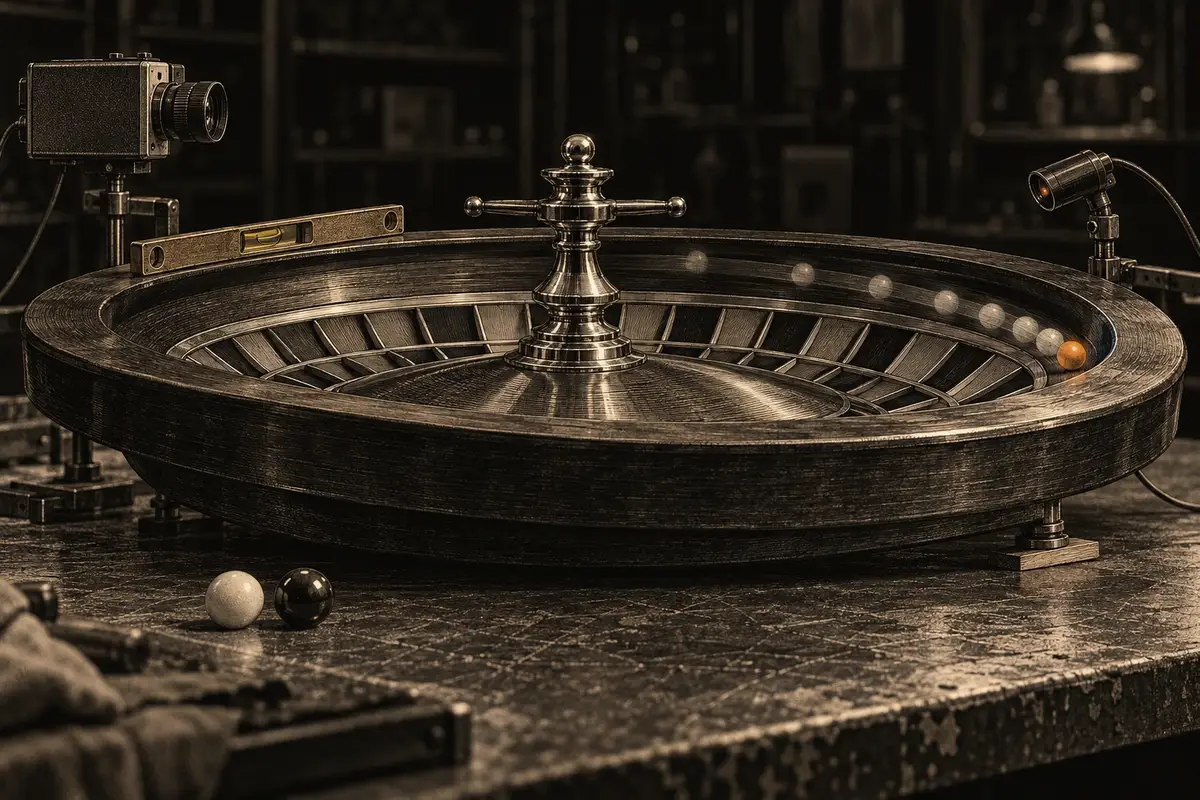
Nga tshifhinga tsha ṱavhanyedzi tsha 1976 Farmer na Dan Browne vho badela $1,500 nga tshelede ya tshanḓani kha vhili ḽa khasino ḽo lugiswaho hafhu kha vhurekisi ha ngei Reno, vha tshi ri ndi ḽa phathi ya tshigwada tsha vhagudi. Lwa miṅwedzi vho ḽi hwala vhusiku u ḽi isa kha laborathori ya u gudisa ya yunivesithi nahone vha ḽi kala nga zwiṱoli zwa infrared, tshifhinga tsha eḽekiṱhironiki tsho itwaho hayani na khamera ye ya vha i tshi thoma nga mubvumo wa bola i tshi rwa tshitei. Zwe vha zwi wana zwi kha ḓi vha mutevhe mupfufhi wavhuḓi wa zwi re na ndeme kha mumono. Muya ndi wone u ḓiṱisaho bola vhukuma, u fhira nḓila. Vhili ḽi songo linganaho nga tshipiḓa tsha fumi tsha intshi fhedzi ḽi shandukisa hune bola ya bva hone kha nḓila, nahone kha vhili ḽo kotamaho bola i ṱoḓa u bva kha thungo ya nṱha, zwine zwa leludza u humbulela. Dzibola dzi a fhambana: bola ya Teflon yo ḓiṱa luvhili nga u ṱavhanya u fhira ya tshithu tsha bola ya biḽiyadi. Nahone musi bola yo no bva kha nḓila i kha ḓi fhufha, nga tshivhalo tsha vhukati i sa fhiri kotara u swika kha tshipiḓa tshiraru tsha u mona. U fhufha uho ho vha hu mbudziso ye pulane yoṱhe ya vha yo ḓitika khayo, nahone ho vha hu songo lapfa lune ha nga tshinya u humbulela. Magumoni a tshilimo vho vhea mbuelo i konadzeaho kha 44%, tshivhalo tshe Thorp a tshi ṋea kha tshishumiswa tshawe.
Khamphani na phai
Vho vhidza bindu Eudaemonic Enterprises, u bva kha ipfi ḽa Tshigerika ḽa dakalo ḽa vhutshilo vhu tshilwaho nga u humbula. Muthu muṅwe na muṅwe we a shuma khaḽo o vha a tshi ḓo badelwa nga tshelede ine ya ḓo kundiwa tshifhingani tshi ḓaho u ya nga awara dze a shuma: tshipiḓa tsha zwe vha zwi vhidza Eudaemonic Pie. Tshelede yo kundiwaho yo vha i tshi fanela u badela tshitshavha tsha khonani tshi itaho saintsi nga nḓila yatsho.
Khomphiyutha nga fhasi ha tshanḓa, 1976–1978
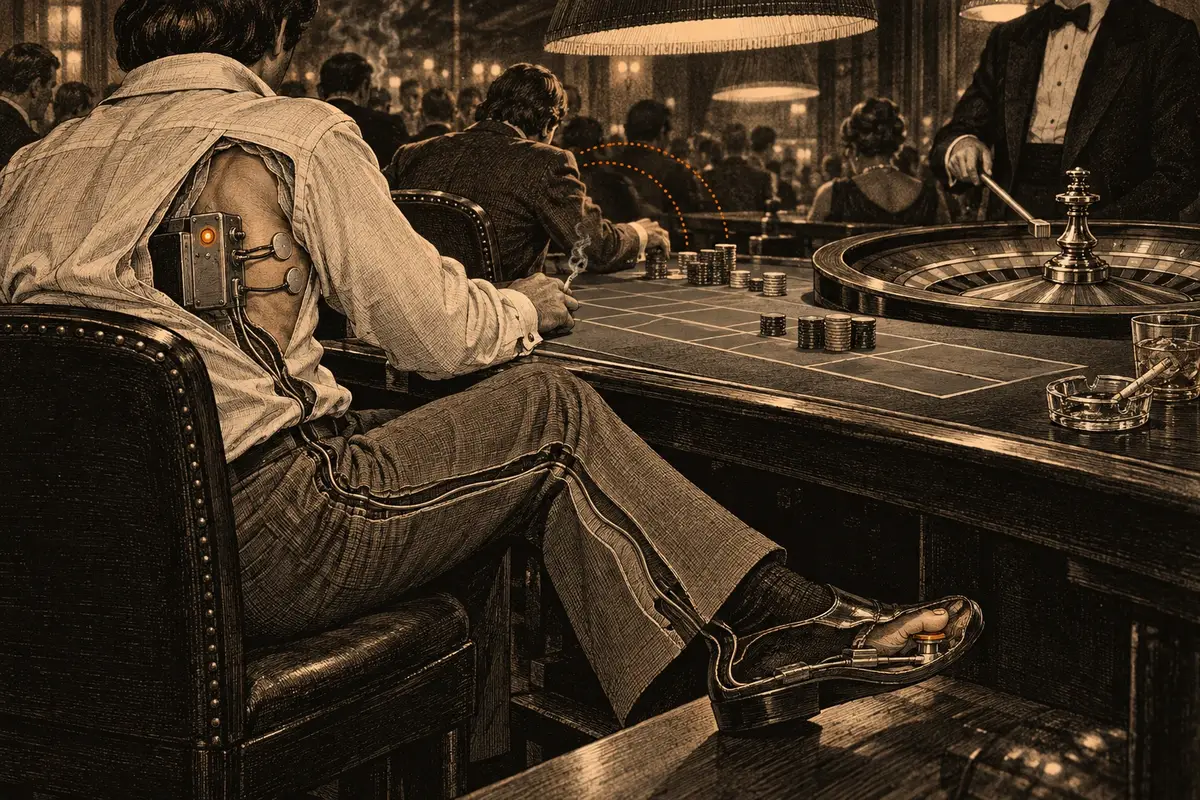
Farmer says the first equipment was worn under the arm and a later version fitted inside a shoe. Toe switches supplied timing information, and vibrating signals communicated the prediction. One person measured the ballzwishumiswaBolaBola ṱhukhu ine ya poswa kha nḓila nga thungo yo fhambanaho na rotara. Bola dza ano maḓuvha dzi itwa nga ivorine kana Teflon, 18–21 mm.Vhalani zwoṱhe → and rotorzwishumiswaRotaraTshipiḓa tsha vhili tshine tsha mona nahone tsho fara mabuli.Vhalani zwoṱhe →; another placed bets. The method needed enough time between measuring the spin and the close of betting.
Tshilimo tsha 1978
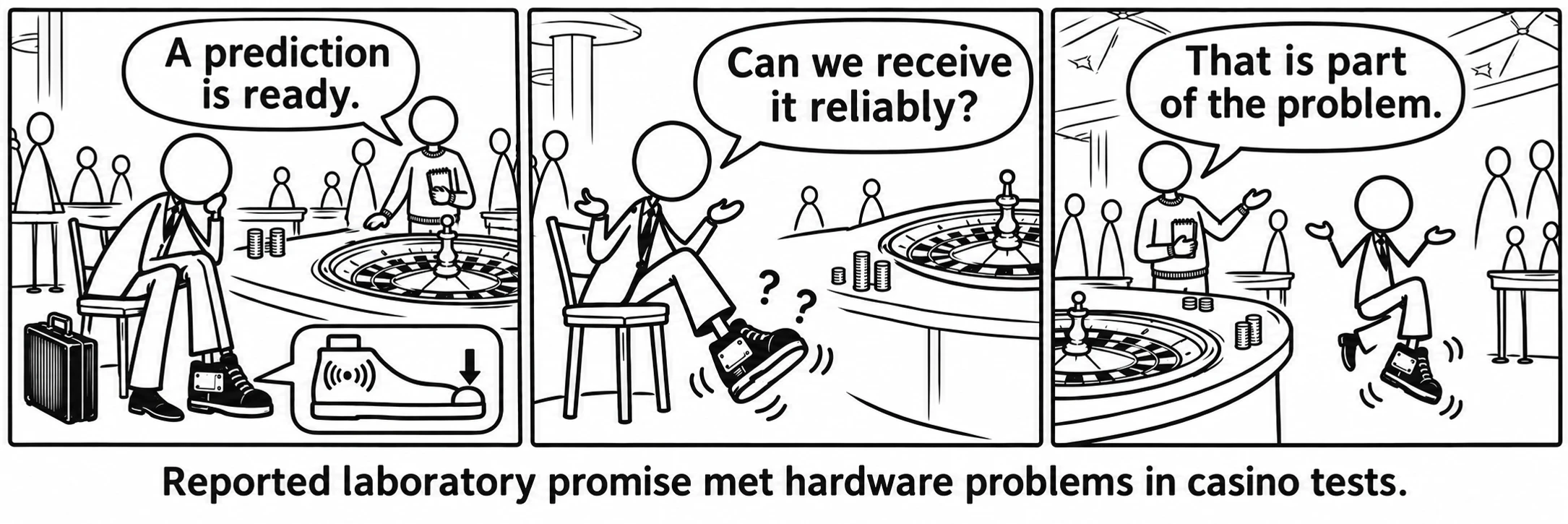
A useful prediction still has to reach the bettor in time. The computer, switches, power supply and communication link all form part of that system. A failure at any stage can make an otherwise useful calculation impossible to act on. This is why a model’s estimated advantage should not be treated as the return of a working casino device.
U ela vhili na khomphiyutha i ambarwaho, zwo ṱalutshedzwa nga Farmer.
Myuziamu i ṱalutshedza uri u kwamana ha radio ho khakhisa ndingo ya Sundance.
Bugu ya Thomas Bass, The Eudaemonic Pie, i a gandiswa.
Khomphiyutha ngomu ha tshienda, 1980–1981
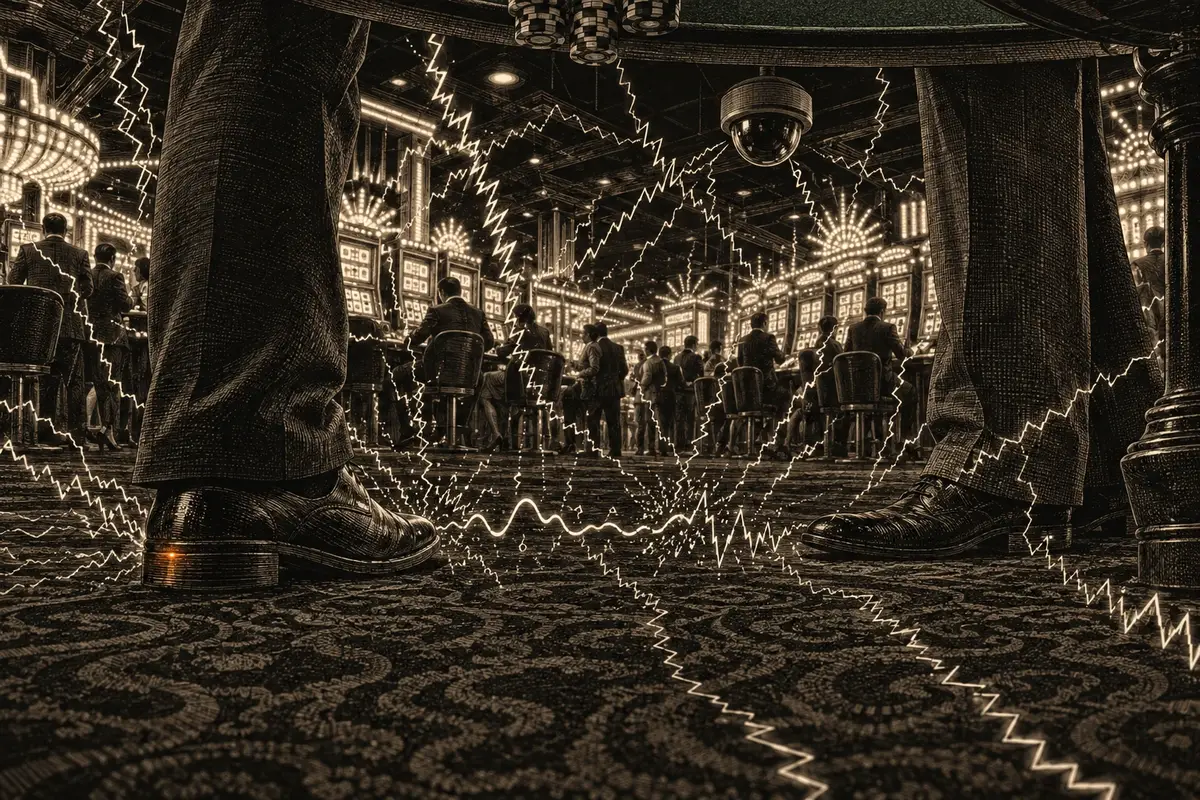
The Heinz Nixdorf MuseumsForum, which displays the shoe computer, describes a November 1981 trial at the Sundance in Las Vegas. Farmer used a toe switch to time the ball. A transmitter sent the predicted wheel sectorvhiliTshipiḓaMabuli a tevhekanaho kha vhili, a ita tshipiḓa tsha tshiṱuluwa, zwi fhambanaho na tshigwada kha mapa wa tafula.Vhalani zwoṱhe → to Bass, who received vibrating signals in his shoe and placed the bets.
The museum reports that casino electronics disrupted the radio link and made the signals unreadable. The team decided against another lengthy rebuild. Its account supports a hardware problem during that trial, not a general claim that electronic prediction always succeeds or always fails.
Zwine 44% ya amba
On a uniform American wheel, a fixed straight-up bet wins with probabilitymathematikiKhonadzeoKhonadzeo ya mvelelo, u bva kha 0 u ya kha 1 kana 0% u ya kha 100%. Nomboro nthihi: 1/37 = 2.70%.Vhalani zwoṱhe → 1/38. At a 35:1 net payouttsheledeMbadeloZwine bete yo kundaho ya humisa, zwi tshi ambiwa sa “X kha 1” nṱha ha tshelede ya bete i humiswaho.Vhalani zwoṱhe →, its expected return is 36/38 − 1, or −5.26%. If a prediction method truly raises the hit probability to 1/25 on the bets selected, the same calculation gives +44%.
This is conditional arithmetic, not a measurement of the Eudaemons’ device. A real estimate would need the bets placed, the outcomes and uncertainty. Predicting a sector also differs from making a single-number bet; the return must be calculated across the full stake.
Ndi ngani mbuelo khulwane yo vha i tshi kha ḓi pfala sa vhugembuli
A positive expected return does not make a short session predictable. In an illustrative model with independent spinsmathematikiMimono i ḓiimisahoMumono muṅwe na muṅwe u na khonadzeo dzi fanaho hu sa londwi zwo fhiraho. Ndi mutheo wa u vhalela hoṱhe kha saiti ino.Vhalani zwoṱhe →, one unittsheledeYunitiTshelede ya bete ya mutheo ine sisiṱeme kana mutambi a shuma ngayo. Nyengedzo dza bete dzi ṱalutshedzwa nga dziyuniti uri dzi shume kha tafula iṅwe na iṅwe.Vhalani zwoṱhe → on a single number each spin, a true hit probability of 1/25 and a 35:1 payout, the player is still behind after 100 spins about 23.2% of the time. That is the probability of zerovhiliZiroBuli ḽithihi ḽa muvhala wa tala ḽine ḽa sa farwe nga bete ya tshelede i linganaho, ya dazini kana ya kholomu; ndi tshisima tsha mbuelo ya khasino. Ḽi dovha ḽa vhidzwa: ziro nthihi, 0.Vhalani zwoṱhe →, one or two wins.
This example is not a reconstruction of the group’s sector bets. Smaller stakes reduce the money exposed, but they do not eliminate losses or establish that a particular bankrolltsheledeTshelede ya u tambaTshelede yoṱhe yo vhewaho thungo u itela u tamba. Ndangulo ya tshelede ya u tamba ndi u dzhia tsheo ya uri ni ḓo khakhisa nngafhani kha bete iṅwe na iṅwe na kha seshini iṅwe na iṅwe.Vhalani zwoṱhe → is safe.
Zwe zwa lozwisa na zwe zwa badela
Bass’s preview gives a 44% advantage estimate; Farmer’s retrospective account reports 20%. These figures should stay attached to their sources. Without matching test conditions and betting records, they are not interchangeable measurements.
A percentage advantage is also different from money earned. Net profit would need to account for stakes, payouts, equipment and other costs. The sources used here do not establish a complete audited profit-and-loss account.
U vhala bugu ṋamusi
Thomas Bass, we a vhea dzibete kha lwendo lwa u fhedza, o anetshela mafhungo aya kha The Eudaemonic Pie (1985), yo fhaṱwaho nga dziinthaviyu ndapfu na tshigwada, nahone ndi yone tshisima tsha siaṱari iḽi. Ḓivhazwakale yayo pfufhi ya rulete a i fulufhedzei u fana na mafhungo ayo a thandela. I dovholola nganea ya vhaṅwali vha rathi vho hiriwaho nga Jagger, ine ya swika kha bugu ya 1901 fhedzi hu si phanḓa (sedzani Joseph Jagger), nahone i vhea ndingo ya khasino ya Thorp na Shannon nga 1962, hune mafhungo a Thorp ene muṋe a ri ndi tshilimo tsha 1961.
Mbudziso
Hai. Vho kunda dzidola dzi si gathi dza zwigidi nga bete dza sente dza fumi na dza kotara, nahone vha fhedza dzidola dzi ṱoḓaho u vha $15,000 na zwigidi zwinzhi zwa awara.
Musi vha tshi tamba, Nevada yo vha i si na mulayo u iledzaho u humbulela mutambo nga tshishumiswa. I na wone u bva nga 1985, nahone fhethu hunzhi hu re na dzikhasino zwino hu na wone.
Hai fhethu hune u vhea bete ha vala musi bola i tshi posiwa, sa zwine zwa itea kha dzisitudio dza tshifhinga tsha zwino, nahone u hwala tshishumiswa tsho raloho u dzhena khasino ndi vhutshinyi kha mashango manzhi.
Mathematiki ya u ḓiphina
Lingedzani hedzi nga inwi vhaṋe u thoma. Phindulo iṅwe na iṅwe yo dzumbiwa; i voreni musi no no ḓilugisa.
Suppose a prediction gives a straight-up bet paying 35:1 an expected return of +44% of its stake. What hit probabilitymathematikiKhonadzeoKhonadzeo ya mvelelo, u bva kha 0 u ya kha 1 kana 0% u ya kha 100%. Nomboro nthihi: 1/37 = 2.70%.Vhalani zwoṱhe → does that require? On a 38-pocketzwishumiswaBuliḼiṅwe ḽa mabuli a 37 o ṅwalwaho nomboro kha rotara. Ḽi dovha ḽa vhidzwa: slot, cup.Vhalani zwoṱhe → wheel, how many pockets would need to be excluded in a model that assigns equal probability to every remaining pocket?
Sumbedzani phindulo
Phindulo Luthihi kha mimono ya 25. Izwo zwi fana na u bvisa mabuli a 13 na u sia a 25.
A winning chiptsheledeTshipisiTshiga tshine tsha imela tshelede yo tiwaho, tshi vhewaho kha mapa wa tafula u vhea bete. Tshi dovha tsha vhidzwa: check.Vhalani zwoṱhe → comes back with 35 more: 36 chips. If the number wins once in n spins, n chips staked bring 36 back, so the bet is worth 36/n − 1.
Set that to 0.44: 36/n = 1.44, so n = 25. With no prediction n is 38 and the bet is worth 36/38 − 1 = −5.26%.
Now suppose a prediction rules out k pockets and the ballzwishumiswaBolaBola ṱhukhu ine ya poswa kha nḓila nga thungo yo fhambanaho na rotara. Bola dza ano maḓuvha dzi itwa nga ivorine kana Teflon, 18–21 mm.Vhalani zwoṱhe → is equally likely to land in each of the other 38 − k. A chip on one of those wins once in 38 − k spins. For 44% we need 38 − k = 25, so k = 13: a little more than a third of the wheel.
This equivalence depends on equal probabilities across the remaining pockets. Excluding eight of 38 pockets gives 36/30 − 1 = +20% in this model. Different probability distributions require their own calculation; this exercise does not measure a historical team’s performance.
mabuli o bviswahomabuli o salahondeme ya bete ya nomboro nthihi038−5.26%2360%830+20%1325+44%1919+89%Humbulani uri nomboro yaṋu i kunda vhukuma luthihi kha mimono ya 25 nga 35 kha 1, mbuelo ya mutambi ya 44%. Ni vhea tshipisi tshithihi kha mumono. Ni na khonadzeo ifhio ya u vha murahu nga murahu ha mimono ya 100? Nga murahu ha 500?
Sumbedzani phindulo
Phindulo Hu ṱoḓa u vha 23% nga murahu ha mimono ya 100 nahone i kha ḓi vha 6% nga murahu ha 500.
After 100 spins you have staked 100 chips, and each win brings back 36. Two wins bring 72, a loss of 28; three bring 108, a gain of 8. So you are behind if you win twice or less.
The chance of no win in 100 spins is (24/25)¹⁰⁰ = 1.7%. Exactly one win: 100 × (1/25) × (24/25)⁹⁹ = 7.0%. Exactly two: 4,950 × (1/25)² × (24/25)⁹⁸ = 14.5%. Together 23.2%.
After 500 spins you need 14 wins to be ahead (14 × 36 = 504), and the average is 20. The chance of 13 or fewer is about 6.2%.
A positive expected return can coexist with a substantial chance of finishing behind. These binomial results assume independent spinsmathematikiMimono i ḓiimisahoMumono muṅwe na muṅwe u na khonadzeo dzi fanaho hu sa londwi zwo fhiraho. Ndi mutheo wa u vhalela hoṱhe kha saiti ino.Vhalani zwoṱhe →, a stable hit probability of 1/25, and enough funds to place every planned bet. They do not establish that a real prediction has that accuracy.
mimonou kunda hu ṱoḓeaho u vha phanḓakhonadzeo ya u vha murahu50240.0%100323.2%200618.6%500146.2%Bugu i ri nga mbuelo ya 44%, $100 yo vhewaho lwa 50 nga awara i fanela u wana $2,200 nga awara. Ṱolani izwo. Nga murahu shumani zwine mbuelo yeneyo ya wana kha tshelede ya bete ye tshigwada tsha vha tshi tshi tamba ngayo vhukuma: sente dza fumi kha mumono.
Sumbedzani phindulo
Phindulo +$2,200 at $100 per bet; +$2.20 at $0.10 per bet; +$8.80 with four $0.10 bets per spin. These are expectations, not hourly guarantees.
Expected profit is the amount staked multiplied by the player edge. At $100 per spin and 50 spins an hour, turnovertsheledeTshelede yoṱhe ya dzibeteTshelede yoṱhe yo vhewaho kha seshini kana tshifhinga, hu tshi katelwa tshelede yo kundiwaho ye ya dovha ya vhewa. I dovha ya vhidzwa: handle, action.Vhalani zwoṱhe → is $5,000 and expected profit is $5,000 × 0.44 = $2,200.
At $0.10 per spin, hourly turnover is $5 and the expectation is $2.20. Four $0.10 bets per spin make turnover $20 and expectation $8.80, provided each bet really retains the assumed 44% edge.
The arithmetic scales with stakes. It does not establish a real-world edge or describe the stakes, earnings or motives of a historical group.
Zwa u sea
Fiziki yo shuma. Neon ya kunda.
Zwiko
- Bass, T. A. The Eudaemonic Pie.
- Thorp, E. O. “Optimal gambling systems for favorable games.”
- Thorp, E. O. “The invention of the first wearable computer.”
- Nevada Revised Statutes, ndima ya 465.
- Nevada NRS 465.075 — maṅwalwa a zwino o ṱolwa nga 15 Ḽara 2026
- Heinz Nixdorf MuseumsForum, Shoe computer — tsengo ya Sundance
- J. Doyne Farmer, Roulette — mafhungo a muḓivhi
- Thomas Bass, The Eudaemonic Pie — tshipiḓa tshi vhonalaho kha vhathu voṱhe