Thaidzo: Mukano wa Tafula
Martingale ya $10 kha tafula ya $500. I kwashea lungana, i lozwa zwingana musi i tshi kwashea, nahone u gonyisa mukano zwi a thusa naa?
U lozwa lwa rathi nga u tevhekana zwi i kwasha: 1.8% nga mutevhe, hu tshi ḓi vha 60% ya dziseshini dza mimono ya 100. U kwashea hu ḓura $630. U gonyisa mukano u swika $5,000 zwi ita uri u kwashea hu sa ite kanzhi (0.25% nga mutevhe) fhedzi hu vhe hu hulwane ($5,110). Ndozwo yo lavhelelwaho nga dolara yo vhewaho ndi 2.70% kha mukano muṅwe na muṅwe.
Thaidzo
Assume independent spinsmathematikiMimono i ḓiimisahoMumono muṅwe na muṅwe u na khonadzeo dzi fanaho hu sa londwi zwo fhiraho. Ndi mutheo wa u vhalela hoṱhe kha saiti ino.Vhalani zwoṱhe → and standard single-zerovhiliZiroBuli ḽithihi ḽa muvhala wa tala ḽine ḽa sa farwe nga bete ya tshelede i linganaho, ya dazini kana ya kholomu; ndi tshisima tsha mbuelo ya khasino. Ḽi dovha ḽa vhidzwa: ziro nthihi, 0.Vhalani zwoṱhe → payoutstsheledeMbadeloZwine bete yo kundaho ya humisa, zwi tshi ambiwa sa “X kha 1” nṱha ha tshelede ya bete i humiswaho.Vhalani zwoṱhe →, with enough bankrolltsheledeTshelede ya u tambaTshelede yoṱhe yo vhewaho thungo u itela u tamba. Ndangulo ya tshelede ya u tamba ndi u dzhia tsheo ya uri ni ḓo khakhisa nngafhani kha bete iṅwe na iṅwe na kha seshini iṅwe na iṅwe.Vhalani zwoṱhe → to fund each permitted stake. A player bets $10 on redbeteTswukuBete ya tshelede i linganaho kha nomboro dza 18 tswuku. Nga Lufurantsi: rouge.Vhalani zwoṱhe → and doubles after each loss, resetting after a win. The table maximum is $500. (a) How many consecutive losses break the progressiontshiṱirathedzhiNyengedzo ya beteMulayo muṅwe na muṅwe une wa shandukisa tshelede ya bete u ya nga mvelelo dzo fhiraho. Nyengedzo nga murahu ha u lozwa i i engedza nga murahu ha ndozwo, nyengedzo nga murahu ha u kunda i i engedza nga murahu ha u kunda.Vhalani zwoṱhe →? (b) What is the probabilitymathematikiKhonadzeoKhonadzeo ya mvelelo, u bva kha 0 u ya kha 1 kana 0% u ya kha 100%. Nomboro nthihi: 1/37 = 2.70%.Vhalani zwoṱhe → per cycle? (c) What is lost at the break? (d) How does a $5,000 limit change the answers? (e) Does any limit make the system profitable?
Phindulo (a)–(c)
Tshelede ya bete: 10, 20, 40, 80, 160, 320. Ya vhusumbe i nga vha 640 > 500, ngauralo ndozwo dza rathi dzi a i kwasha. (b) p(ndozwo) = 19/37 kha tswuku; (19/37)⁶ = 0.0183, hu tshi ḓi vha 1.8% nga mutevhe. Mutevhe u fhela nga murahu ha mimono i tshi ḓi vha mivhili nga tshivhalo tsha vhukati, ngauralo seshini ya mimono ya 100 i na mitevhe i tshi ḓi vha 50 nahone p(u kwashea luthihi nga u fhungudza) ≈ 1 − 0.9817⁵⁰ ≈ 60%. (c) 10 + 20 + 40 + 80 + 160 + 320 = $630, zwine zwa vha dziyunititsheledeYunitiTshelede ya bete ya mutheo ine sisiṱeme kana mutambi a shuma ngayo. Nyengedzo dza bete dzi ṱalutshedzwa nga dziyuniti uri dzi shume kha tafula iṅwe na iṅwe.Vhalani zwoṱhe → dza mathomo dza 63, musi zwi tshi vhambedzwa na $10 ye mutevhe wa vha u tshi khou lingedza u i kunda.
Phindulo (d)
At $5,000: stakes to 2,560 are allowed; the tenth stake, 5,120, is refused. Nine losses break it: (19/37)⁹ ≈ 0.25% per cycle, about 11% of 100-spin sessions. Loss at the break: 10 + 20 + … + 2,560 = $5,110. The player has bought a rarer catastrophe at the price of a larger one. Over many sessions the expected cost of breaks is p × loss ≈ 0.0183 × 630 = $11.5 per cycle at the $500 limit and 0.0025 × 5,110 = $12.8 at $5,000; each is the expected contribution from failed cycles. Subtract the expected profit from successful cycles, $10 × (1 − p), to obtain total expected lossmathematikiNdozwo yo lavhelelwahoNdeme yo lavhelelwaho yo andiswa nga tshelede yoṱhe yo vhewaho; tshelede ine ya lozwiwa nga tshivhalo tsha vhukati kha seshini kana tshifhinga.Vhalani zwoṱhe → per cycle: about $1.74 and $2.71 respectively.
Phindulo (e)
With a finite limit and a well-defined stopping rule, expected loss equals expected turnovertsheledeTshelede yoṱhe ya dzibeteTshelede yoṱhe yo vhewaho kha seshini kana tshifhinga, hu tshi katelwa tshelede yo kundiwaho ye ya dovha ya vhewa. I dovha ya vhidzwa: handle, action.Vhalani zwoṱhe → divided by 37. Changing the limit can change turnover substantially. For the 100-spin examples below, the player resets to $10 after either a win or a failed progression, and has enough money to place every bet. These are exact model expectations, not a simulation. The imaginary unlimited-bankroll, unlimited-stake MartingaletshiṱirathedzhiMartingaleNyengedzo ya bete ine ya andisa bete nga mbili nga murahu ha u lozwa huṅwe na huṅwe. Vhonani khethekanyo ya Zwiṱirathedzhi u ḓivha zwine ya zwi ita na zwine ya sa zwi ite.Vhalani zwoṱhe → is different: a single cycle eventually wins $10 with probability 1, but its expected turnover is infinite. The finite-expectation identity cannot be applied to that unbounded stopping problem. Real bankrolls and tables cannot implement it.
Dzitafula mbili dza vhukuma
Tsumbo ya Thorp ndi tafula ya $1 ine mukano wa nṱha wa vha $1,000, hune mutambi a fulufhela u kunda $30 ya ḽiḓa ḽa madekwana dolara nthihi nga tshifhinga. Tshelede ya bete ya 1, 2, 4 … 512 i tendela dzibete fumi, ngauralo ndozwo fumi dzo tevhekanaho dzi kwasha nyengedzo: luthihi kha mitevhe ya 785 kha vhili ḽa Yurophu (luthihi kha 613 kha ḽa Amerika), nga mutengo wa $1,023. Mitevhe ya furaru yoṱhe i bvelela lwa 96.2% ya tshifhinga. Dziṅwe 3.8% dzi lozwa hu tshi ḓi vha $1,000, nahone mvelelo ya tshivhalo tsha vhukati ya madekwana ndi −$9.17, zwine zwa vha 1/37 vhukuma ya $339 ine mitevhe ya furaru ya i vhea nga tshivhalo tsha vhukati. Tafula ya $5 ine mukano wa nṱha wa vha $2,000 a i fhambani: tshelede ya bete u swika $1,280 i tendela dzibete ṱahe, nahone u kwashea hu ḓa luthihi kha mitevhe ya 403 kha vhili ḽa Yurophu (luthihi kha 323 kha ḽa Amerika) nahone hu ḓura $2,555.
Mutambi o pfumaho
The table maximum is only one constraint. The player may run out of money before reaching it. A simulation must state whether it stops, resets to the base stake or bets the remaining balance when the next double is unaffordable. Those choices change session probabilities, so results from one rule cannot describe every Martingale strategy.
Ngudo
A higher limit permits rarer but larger failed progressions. It does not remove the negative expectation of each standard bet, and it may increase the amount wagered. Compare the total exposure and stopping rule as well as the chance of a short winning cycle.
Fomula
Mbudziso
I ni konisa u tshila u swika kha mukano wa nṱha, hune u kwashea ha vha hu sa iteiho kanzhi fhedzi hu hulwane. Ndozwo yo lavhelelwaho nga dolara a i shanduki.
Tshelede ya bete 10, 30, 70, 150, 310: mukano wa $500 u swikelwa nga murahu ha ndozwo ṱhanu, nahone u kwashea hu ḓura $570. Ndi 2.70% i fanaho.
A maximum limits the payout exposure accepted on a bet. The operator sets the actual limits; their existence does not create roulette’s house edgemathematikiMbuelo ya khasinoTshipiḓa tsha tshelede ya bete iṅwe na iṅwe tshine khasino ya tshi vhulunga nga tshivhalo tsha vhukati: 2.70% kha rulete ya Yurophu.Vhalani zwoṱhe →.
Mathematiki ya u ḓiphina
Lingedzani hedzi nga inwi vhaṋe u thoma. Phindulo iṅwe na iṅwe yo dzumbiwa; i voreni musi no no ḓilugisa.
A MartingaletshiṱirathedzhiMartingaleNyengedzo ya bete ine ya andisa bete nga mbili nga murahu ha u lozwa huṅwe na huṅwe. Vhonani khethekanyo ya Zwiṱirathedzhi u ḓivha zwine ya zwi ita na zwine ya sa zwi ite.Vhalani zwoṱhe → starts at $100 on redbeteTswukuBete ya tshelede i linganaho kha nomboro dza 18 tswuku. Nga Lufurantsi: rouge.Vhalani zwoṱhe → and allows itself at most n bets a cycle: after n losses in a row it gives up and starts again. Write the average result of one cycle as a formula in n, and work it out for 5, 6 and 7 bets on a European wheel. Assume independent uniform single-zerovhiliZiroBuli ḽithihi ḽa muvhala wa tala ḽine ḽa sa farwe nga bete ya tshelede i linganaho, ya dazini kana ya kholomu; ndi tshisima tsha mbuelo ya khasino. Ḽi dovha ḽa vhidzwa: ziro nthihi, 0.Vhalani zwoṱhe → results and sufficient funds for every permitted stake.
Sumbedzani phindulo
Phindulo Tshivhalo tsha vhukati ndi 100 × (1 − (38/37)ⁿ): −$14.26 kha dzibete dza 5, −$17.35 kha dza 6 na −$20.52 kha dza 7. U tendela dzibete nnzhi zwi ita uri tshikhala tsha vhukati tshi vhe tshi si khwine, a si khwine.
A cycle wins $100 unless all n bets lose, which happens with chance qⁿ, where q = 19/37. When they all lose, the stakes 100, 200 … 100 × 2ⁿ⁻¹ add up to 100 × (2ⁿ − 1). So the average is 100 × (1 − qⁿ) − 100 × (2ⁿ − 1) × qⁿ = 100 × (1 − (2q)ⁿ).
Here 2q = 38/37, a little more than 1, so (2q)ⁿ grows with n and the average falls: n = 5 gives 1.1426 and −$14.26; n = 6 gives 1.1735 and −$17.35; n = 7 gives 1.2052 and −$20.52. A longer ladder loses less often, in 3.6%, 1.8% and 0.9% of cycles, but each loss is twice as large, and more money crosses the table each cycle, at 2.70% of every bet.
On an American wheel 2q = 40/38 and the figures are −$29.24, −$36.04 and −$43.20. In a game with no zero 2q = 1, and every cycle averages exactly zero however long the ladder.
“Martingale khulwane” i andisa tshelede ya bete lwa vhuvhili nga murahu ha ndozwo nahone ya engedza yunititsheledeYunitiTshelede ya bete ya mutheo ine sisiṱeme kana mutambi a shuma ngayo. Nyengedzo dza bete dzi ṱalutshedzwa nga dziyuniti uri dzi shume kha tafula iṅwe na iṅwe.Vhalani zwoṱhe → nthihi, ngauralo tshelede ya bete i ya sa 1, 3, 7, 15, 31 … Ni phanḓa nga vhugai musi u kunda ha u thoma hu tshi da kha bete ya 1, ya 2, ya 3 kana ya k? Nga yuniti ya $10 na mukano wa nṱha wa $500, tshikhala tshi kwashea kangana, nahone tshikhala tshi ḓura vhugai nga tshivhalo tsha vhukati?
Sumbedzani phindulo
Phindulo U kunda kha bete ya k hu ni sia ni phanḓa nga dziyuniti dza k: +1, +2, +3 na zwiṅwe-vho. Nga $10 na $500 tshikhala tshi kwashea nga murahu ha ndozwo ṱhanu, 3.57% ya zwikhala, nga −$570. Nga tshivhalo tsha vhukati tshikhala tshi lozwa $2.32 kha $85.73 yo vhewaho: 2.70%.
The kth stake is 2ᵏ − 1 units: 1, 3, 7, 15, 31. The first k − 1 stakes add up to 2ᵏ − 2 − (k − 1) = 2ᵏ − k − 1. A win on the kth bet pays 2ᵏ − 1, so the cycle ends (2ᵏ − 1) − (2ᵏ − k − 1) = k units up: one extra unit for every loss before the win.
At least $570 is needed to fund all five stakes in a fresh cycle. At $10 a unit the stakes are $10, $30, $70, $150 and $310; the next, $630, is over the $500 maximum. Five losses in a row, (19/37)⁵ = 3.57%, cost 10 + 30 + 70 + 150 + 310 = $570.
Average: the wins bring in $10 × k with chance (19/37)ᵏ⁻¹ × 18/37 for k = 1 to 5, and the break takes $570 with chance 3.57%; together −$2.32. The money staked averages $85.73 a cycle, and 2.32/85.73 = 2.70%. The ordinary Martingale at the same table breaks after six losses, 1.83% of cycles, for −$630, and loses $1.74 out of $64.20 staked: 2.70% again.
Mutambi u dzudzanya Martingale kha tswuku nga bete ya u thoma ya $1 kha tafula ine mukano wayo wa vha $1,000, ngauralo dzibete dza fumi dzi a konadzea: $1, $2, $4 na zwiṅwe-vho u swika kha $512. Tshikhala tshi lozwa dzoṱhe dza fumi kangana, zwi dzhia tshifhinga tshingafhani nga tshivhalo tsha vhukati, nahone vhusiku ha dzibete dza 200 vhu fhela nga yeneyo nḓila kangana?
Sumbedzani phindulo
Phindulo Tshikhala tshi lozwa dzoṱhe dza fumi luthihi kha 784, zwine zwa ḓura $1,023. Izwo ndi dzibete dza 1,600 nga tshivhalo tsha vhukati, nahone vhusiku ha dzibete dza 200 vhu rwa luvhondo lwa 11% ya tshifhinga. Tshikhala tshi kha ḓi lozwa $0.31 nga tshivhalo tsha vhukati kha $11.31 yo vhewaho: 2.70%.
Bete kha tswuku i lozwa nga khonadzeo ya 19/37, ziro i tshi katelwa. Fumi dzo tevhekana: (19/37)¹⁰ ≈ 0.00128, hu ṱoḓa u vha 1 kha 784. Tshelede dza bete dza 1 + 2 + 4 + … + 512 dzi ṱangana dza vha $1,023.
Tshikhala tshi dzhia dzibete dza 2.05 nga tshivhalo tsha vhukati, ngauralo zwikhala zwa 784 zwi dzhia dzibete dza 1,600. Hu tshi vhalwa mumono nga mumono, tshitevhekano tsha ndozwo dza fumi tshi bvelela fhethu huṅwe kha dzibete dza 200 lwa 11.3% ya tshifhinga.
Vhukati ha khombo mutambi u kunda $1 kha tshikhala: hu ṱoḓa u vha $783 phanḓa ha tshi si tshavhuḓi, nga murahu −$1,023, hu ṱoḓa u vha −$240 kha tshifhinga tshoṱhe. Kha tshikhala: 1 × (1 − 0.00128) − 1,023 × 0.00128 ≈ −$0.31. Tshelede yo vhewaho kha tshikhala: 1 + 2 × (19/37) + 4 × (19/37)² + … + 512 × (19/37)⁹ ≈ $11.31. Nahone −0.31/11.31 = −2.70%.
Vhambedzani bete ya u thoma ya $10 kha mukano wa $500, dzibete dza rathi: luvhondo lu da luthihi kha zwikhala zwa 55, nahone vhusiku ha dzibete dza 200 vhu lu wana lwa 84% ya tshifhinga. Mukano wa nṱha u ita uri u kwashea hu si itee kanzhi nahone hu vhe huhulwane, a hu ḓuri zwiṱuku.
Zwa u sea
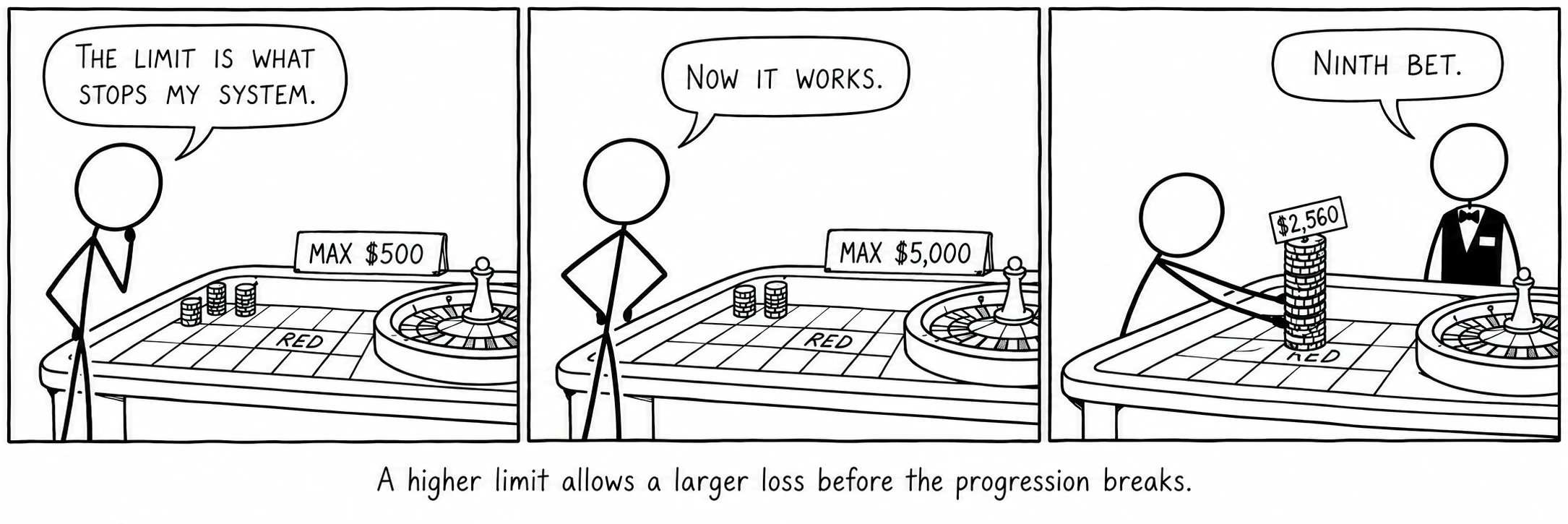
Zwi sa iteiho kanzhi na zwihulwane, kha mukano muṅwe na muṅwe. Mbuelo ya u andisa a i shanduki.
Zwiko
- Ethier, S. N. The Doctrine of Chances: Probabilistic Aspects of Gambling.
- Thorp, E. O. “Optimal gambling systems for favorable games.”
- Thorp, E. O. The Mathematics of Gambling.
- Epstein, R. A. The Theory of Gambling and Statistical Logic, 2nd ed.