Saizi ya Tsumbo
Mimono minzhi-minzhi i ṱoḓeaho phanḓa ha musi tshivhumbeo tshi tshi amba tshithu.

U wana buli ḽi wanalaho lwa 1 kha 30 nṱhani ha 1 kha 37 nga vhuṱanzi vhu pfalaho, hu ṱoḓea mimono i ṱoḓaho u vha 4,400. Buli ḽa 1 kha 35, ḽine ḽa nga vha ḽi tshi lifha zwa vhukuma, ḽi ṱoḓa mimono i ṱoḓaho u vha 70,000.
Ndi ngani i minzhi nga u rali
For n independent spinsmathematikiMimono i ḓiimisahoMumono muṅwe na muṅwe u na khonadzeo dzi fanaho hu sa londwi zwo fhiraho. Ndi mutheo wa u vhalela hoṱhe kha saiti ino.Vhalani zwoṱhe →, the hit count has standard deviationmathematikiPhambuwo ya tshiṱandadiMudzi wa tshikwea wa vhariantsi; tshikhala tsha ḓuvha ḽiṅwe na ḽiṅwe vhukati ha mvelelo na ndeme yo lavhelelwaho.Vhalani zwoṱhe → √(np(1−p)); the estimated hit rate has standard error √(p(1−p)/n). Counts get noisier in absolute terms as n grows, while the uncertainty in the rate shrinks. Halving that rate uncertainty requires about four times as many spins.
Fomula
For a one-sided test of a single pocketzwishumiswaBuliḼiṅwe ḽa mabuli a 37 o ṅwalwaho nomboro kha rotara. Ḽi dovha ḽa vhidzwa: slot, cup.Vhalani zwoṱhe → at the 5% level with 80% power, the required n is approximately ((1.645·√(p₀(1−p₀)) + 0.84·√(p₁(1−p₁))) / (p₁ − p₀))², with p₀ = 1/37 and p₁ the suspected rate. That holds for one pocket chosen in advance. Searching all 37 pockets requires a multiple-testing design; there is no universal sample-size multiplier. This tests departure from 1/37, not a profitable rate above 1/36.
U vhala zwi shumaho
Sample size alone does not make an observation evidence or noise. Specify the effect, test and error rates before collecting data. A small sample can identify an extreme failure, while even a large sample may miss a very small departure. Replication and reliable recording remain necessary.
Mutengo wa data
At 50 spins an hour, recording 10,000 rounds takes 200 hours. Equipment changes during that time can complicate interpretation. That practical constraint does not establish that all bias detection is impossible or that every historical investigation took months.
Saizi ya tsumbo ya mbuelo ya khasino yoṱhe
For a unittsheledeYunitiTshelede ya bete ya mutheo ine sisiṱeme kana mutambi a shuma ngayo. Nyengedzo dza bete dzi ṱalutshedzwa nga dziyuniti uri dzi shume kha tafula iṅwe na iṅwe.Vhalani zwoṱhe → even-money single-zerovhiliZiroBuli ḽithihi ḽa muvhala wa tala ḽine ḽa sa farwe nga bete ya tshelede i linganaho, ya dazini kana ya kholomu; ndi tshisima tsha mbuelo ya khasino. Ḽi dovha ḽa vhidzwa: ziro nthihi, 0.Vhalani zwoṱhe → bet, the mean is −1/37 and the standard deviation is √(1368)/37. After 1,368 independent bets, expected lossmathematikiNdozwo yo lavhelelwahoNdeme yo lavhelelwaho yo andiswa nga tshelede yoṱhe yo vhewaho; tshelede ine ya lozwiwa nga tshivhalo tsha vhukati kha seshini kana tshifhinga.Vhalani zwoṱhe → is one standard deviation of the total. At 10,000 it is about 2.70 standard deviations. Neither threshold guarantees a losing result or validates a system.
Fomula
Mbudziso
No. Grouping helps only when the alternative concentrates enough extra probabilitymathematikiKhonadzeoKhonadzeo ya mvelelo, u bva kha 0 u ya kha 1 kana 0% u ya kha 100%. Nomboro nthihi: 1/37 = 2.70%.Vhalani zwoṱhe → in that sectorvhiliTshipiḓaMabuli a tevhekanaho kha vhili, a ita tshipiḓa tsha tshiṱuluwa, zwi fhambanaho na tshigwada kha mapa wa tafula.Vhalani zwoṱhe →. It can dilute a localized pocket effect.
Ee, arali ṱhoho ya vhili i yeneyo nahone i songo lugiswa. Ndi zwone zwi konḓaho u ḓivha.
Ndi mvelele ya vhaṱoḓisisi. Zwi amba uri u kheluwa ha vhukuma ha vhuhulwane vhu ambiwaho vhu nga wanala lwa iṋa kha ṱhanu.
Zwa u sea
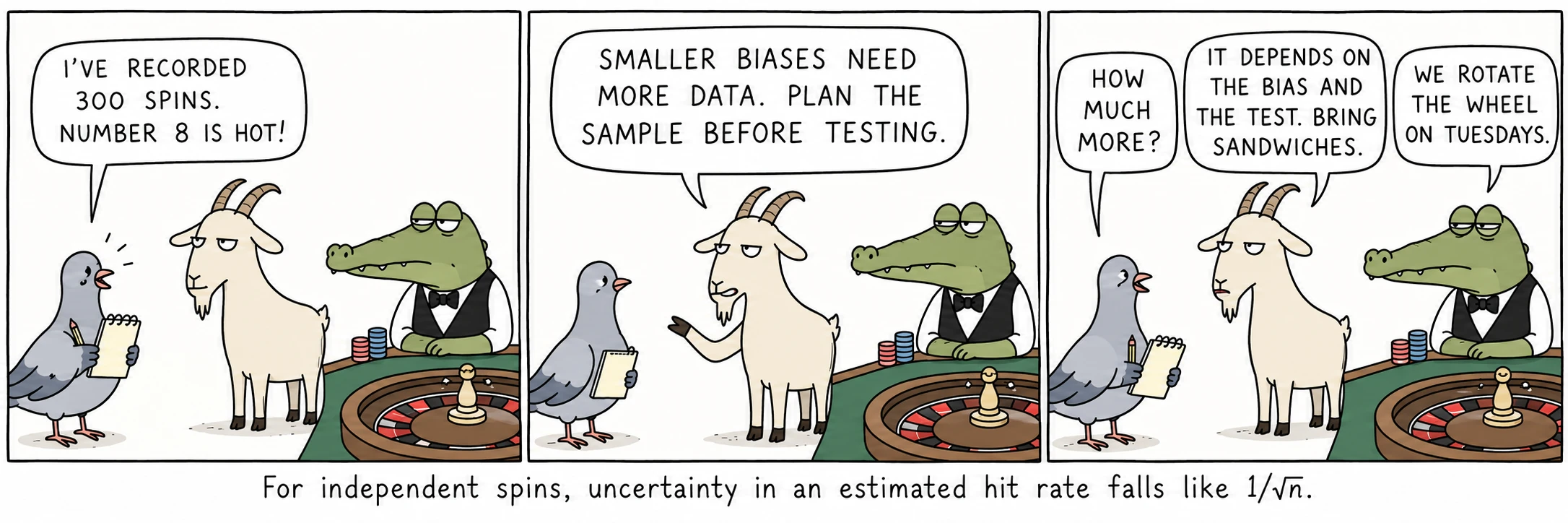
Phambano dza khonadzeo dzi tsela fhasi u fana na 1/√n. U konḓelela hu tsela fhasi nga u ṱavhanya.
Zwiko
- Feller, W. An Introduction to Probability Theory and Its Applications, Vol. 1.
- Barnhart, R. T. Beating the Wheel.
- U vhalela saizi ya tsumbo