Ngano: Nomboro dzi Fanela u Bva
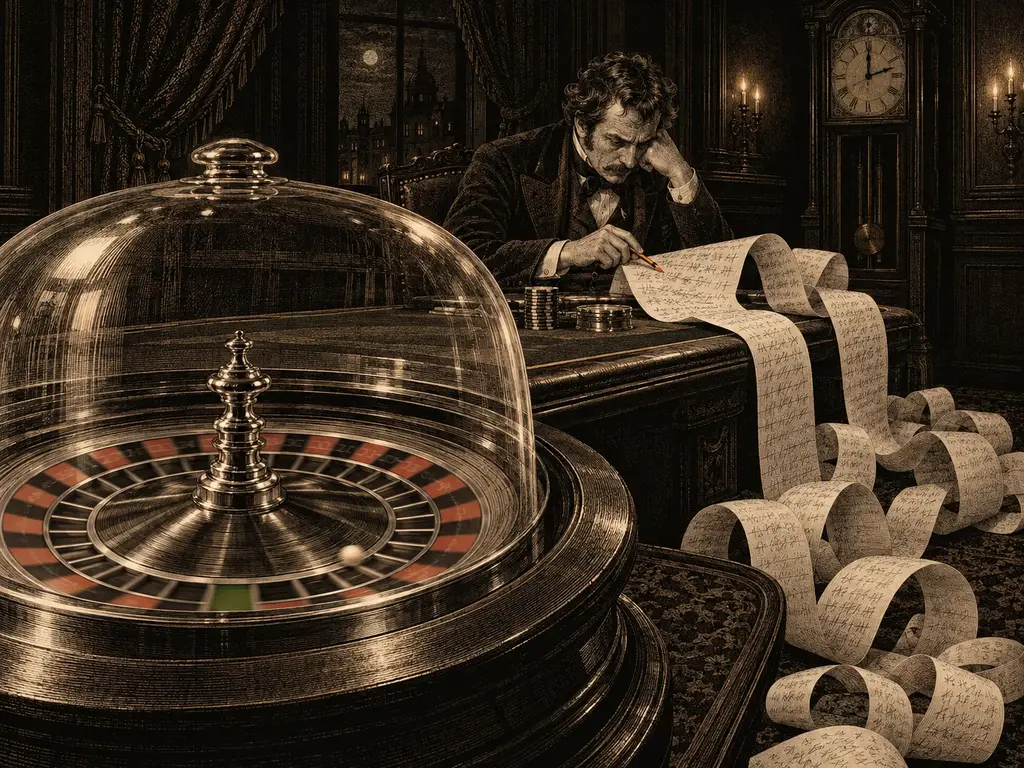
“Fumi na sumbe a i athu u bva kha mimono ya 150. Tshifhinga tshayo tsho swika.” A tsho ngo swika.
On independent uniform single-zerovhiliZiroBuli ḽithihi ḽa muvhala wa tala ḽine ḽa sa farwe nga bete ya tshelede i linganaho, ya dazini kana ya kholomu; ndi tshisima tsha mbuelo ya khasino. Ḽi dovha ḽa vhidzwa: ziro nthihi, 0.Vhalani zwoṱhe → spins, a number’s chance on the next spin remains 1/37, however long it has been absent. Calling it “due” mistakes a long-run proportion for a promise about the next result.
Zwine zwa ambiwa
Dzikhasino dzi sumbedza mvelelo dza u fhedza dza 20 u swika 500 nahone kanzhi dzi swaya nomboro “i rothaho” dzi songo bva lwa tshifhinganyana. Vhatambi vha vhala bodo, vha vhona uri 17 a i athu u bva lwa mimono ya 150, vha vhea bete khayo ngauri tshifhinga tshayo tshi fanela u vha tsho swika. Muhumbulo ndi wa uri nga tshifhinga tshilapfu nomboro iṅwe na iṅwe i bva 1/37 ya tshifhinga, ngauralo nomboro yo salelaho murahu i fanela u swikela.
Ndi ngani zwi si zwone
In the independent uniform model, the next spin has the same probabilities whatever the recorded history. The law of large numbersmathematikiMulayo wa zwivhalo zwihuluTshivhalo tsha vhukati tsha mvelelo dzi ḓiimisaho tshi swika tsini na ndeme yo lavhelelwaho musi tshivhalo tsha ndingo tshi tshi aluwa.Vhalani zwoṱhe → concerns proportions over growing samples; it does not require a missing number to appear more often later. A fixed past gap can become small relative to the total without being repaid.
Ndi ngani zwi tshi pfala zwi zwone
Ngauri kha zwiṅwe zwoṱhe zwa vhutshilo, u sa vha hone hu sumbedza u swika: bisi ḽine ḽa sa ḓe lwa minithi ya fumbili ḽi na khonadzeo khulwane ya u ḓa kha minithi ṱhanu dzi tevhelaho. Zwenezwo ndi ngauri mabisi a na shedulu. Rulete a i na shedulu; i na khonadzeomathematikiKhonadzeoKhonadzeo ya mvelelo, u bva kha 0 u ya kha 1 kana 0% u ya kha 100%. Nomboro nthihi: 1/37 = 2.70%.Vhalani zwoṱhe →, nahone khonadzeo a si tshivhalo tshine tsha fanela u swikelelwa. Muhumbulo uyu ndi wone kha zwinzhi zwa ḽifhasi nahone a si wone kha vhili.
Ndingo
Use a simulation to compare a number selected after a long absence with a number selected in advance. Under independent uniform spins, both have the same next-spin probability. Finite samples will differ, sometimes substantially.
Real-world data can also be used to investigate bias or dependence, but that requires a defined test, enough data for the effect being studied and independent validation. A “hot” or “cold” label alone establishes neither.
Ngano yo shandukiswaho
“It is hot, so it will keep winning” also lacks support under the independent uniform model. For any selected number, the probability of at least one hit in the next 37 spins is 1 − (36/37)^37, about 63.71%. That is a theoretical probability, not the guaranteed result of a short demo session.
Mbudziso
I dzi sumbedza ngauri vhatambi vha a humbela. Bodo ndi ya ngoho nahone a i thusi.
(36/37)⁵⁰⁰ ≈ 0.0001%: a zwi itei kanzhi, nahone i kha ḓi vha 1/37 kha mumono u tevhelaho. Arali zwi tshi dzula zwi tshi itea kha vhili ḽithihi, iyo ndi mbudziso ya u kheluwa, nahone phindulo yo vha i tshi ḓo vha u iledza nomboro iyo.
Hai.
Zwa u sea
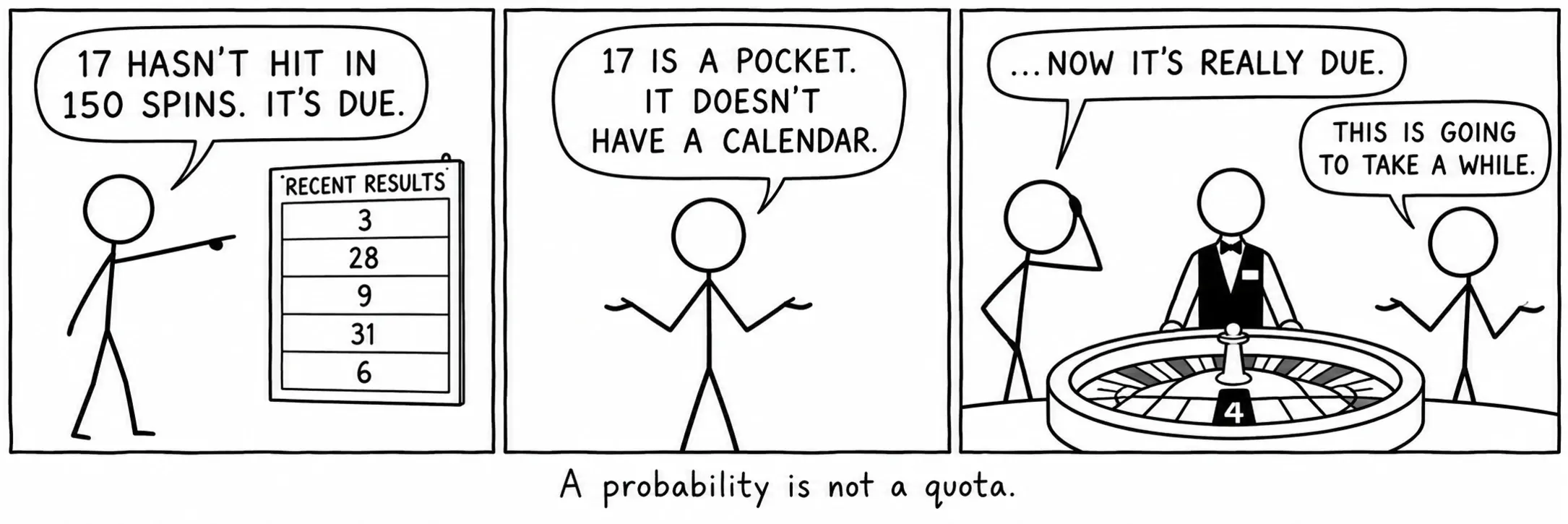
Khonadzeo a si tshivhalo tshine tsha fanela u swikelelwa.
Zwiko
- Feller, W. An Introduction to Probability Theory and Its Applications, Vol. 1.
- Ethier, S. N. The Doctrine of Chances: Probabilistic Aspects of Gambling.