Ḓivhazwakale ya Dzisisiṱeme dza Rulete
Maḓana a miṅwaha mavhili a vhathu vha tshi ṅwala milayo ya u shandukisa tshelede ya bete yavho.
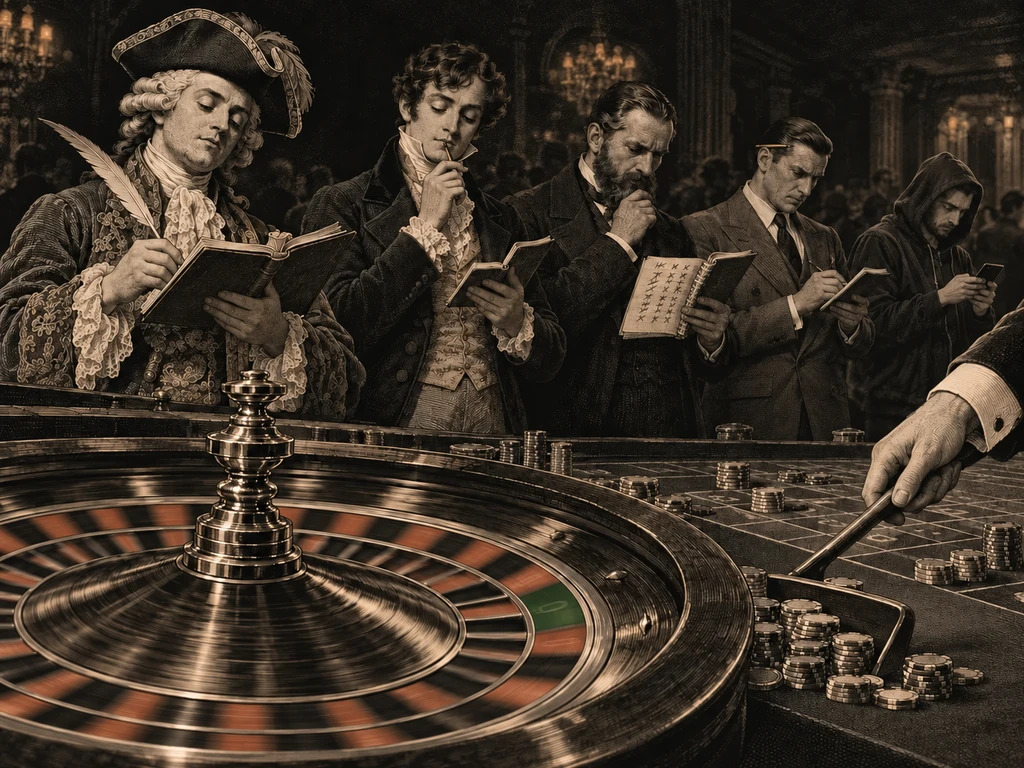
Martingale ndi ya ḓana ḽa vhu-18 ḽa miṅwaha; D’Alembert yo ṋewa dzina ḽa muḓivhi wa mathematiki we a vha a sa i funi; Labouchère ndi zwa u ḓiphina zwa muraḓo wa phalamennde wa tshifhinga tsha Victoria. Na tshenetsho tshifhinga a hu na na nthihi ye ya shuma.
Martingale
The 1762 Académie française dictionary records martingaletshiṱirathedzhiMartingaleNyengedzo ya bete ine ya andisa bete nga mbili nga murahu ha u lozwa huṅwe na huṅwe. Vhonani khethekanyo ya Zwiṱirathedzhi u ḓivha zwine ya zwi ita na zwine ya sa zwi ite.Vhalani zwoṱhe → as a gambling term for staking what has been lost. Its 1878 edition explicitly describes doubling after a loss and also uses the word more broadly for betting schemes. These entries document usage; they do not identify a single inventor.
Today the familiar doubling progressiontshiṱirathedzhiNyengedzo ya beteMulayo muṅwe na muṅwe une wa shandukisa tshelede ya bete u ya nga mvelelo dzo fhiraho. Nyengedzo nga murahu ha u lozwa i i engedza nga murahu ha ndozwo, nyengedzo nga murahu ha u kunda i i engedza nga murahu ha u kunda.Vhalani zwoṱhe → aims to recover previous losses and gain one starting unittsheledeYunitiTshelede ya bete ya mutheo ine sisiṱeme kana mutambi a shuma ngayo. Nyengedzo dza bete dzi ṱalutshedzwa nga dziyuniti uri dzi shume kha tafula iṅwe na iṅwe.Vhalani zwoṱhe → when a win arrives. A finite bankrolltsheledeTshelede ya u tambaTshelede yoṱhe yo vhewaho thungo u itela u tamba. Ndangulo ya tshelede ya u tamba ndi u dzhia tsheo ya uri ni ḓo khakhisa nngafhani kha bete iṅwe na iṅwe na kha seshini iṅwe na iṅwe.Vhalani zwoṱhe → or table limittafulaMukano wa tafulaBete ṱhukhu na khulwane dzine dza tendelwa. Mukano wa nṱha ndi wone u imisaho nyengedzo dza bete dza u andisa nga mbili.Vhalani zwoṱhe → can stop the sequence first. The Strategy section shows how those limits affect a session.
D’Alembert
The progression bearing d’Alembert’s name raises the stake by one unit after a loss and lowers it after a win. The name alone does not prove who devised or endorsed the betting rule.
Its mathematical issue is straightforward: on independent spinsmathematikiMimono i ḓiimisahoMumono muṅwe na muṅwe u na khonadzeo dzi fanaho hu sa londwi zwo fhiraho. Ndi mutheo wa u vhalela hoṱhe kha saiti ino.Vhalani zwoṱhe →, a run of one outcome does not make the opposite outcome due. A famous namesake does not change that assumption or the payouttsheledeMbadeloZwine bete yo kundaho ya humisa, zwi tshi ambiwa sa “X kha 1” nṱha ha tshelede ya bete i humiswaho.Vhalani zwoṱhe →.
Labouchère
The cancellation system uses a list of numbers to determine the next stake. A win removes entries and a loss adds an entry; the Strategy section sets out the rules and examples. Historical stories about its namesake should be distinguished from evidence that the method creates an advantage.
A sequence may clear with a profit, but a losing run can leave a growing list and larger required stakes. How often it clears depends on the starting list, bankroll, limits and stopping rule. There is no universal success percentage.
Rulete ya Monte CarloTshiṱirathedzhi tsha Labouchère kha Rulete
Ḓana ḽa vhu-20 ḽa miṅwaha
A simulation can show how a specified system behaves under a chosen wheel model. It cannot test every possible rule, and a finite run need not return exactly the theoretical house edgemathematikiMbuelo ya khasinoTshipiḓa tsha tshelede ya bete iṅwe na iṅwe tshine khasino ya tshi vhulunga nga tshivhalo tsha vhukati: 2.70% kha rulete ya Yurophu.Vhalani zwoṱhe →.
For independent uniform single-zerovhiliZiroBuli ḽithihi ḽa muvhala wa tala ḽine ḽa sa farwe nga bete ya tshelede i linganaho, ya dazini kana ya kholomu; ndi tshisima tsha mbuelo ya khasino. Ḽi dovha ḽa vhidzwa: ziro nthihi, 0.Vhalani zwoṱhe → spins with standard full-loss-on-zero payouts, each unit staked has expected net return −1/37. For a bounded session whose stakes are chosen using information available before each spin, adding the conditional expectations gives expected lossmathematikiNdozwo yo lavhelelwahoNdeme yo lavhelelwaho yo andiswa nga tshelede yoṱhe yo vhewaho; tshelede ine ya lozwiwa nga tshivhalo tsha vhukati kha seshini kana tshifhinga.Vhalani zwoṱhe → equal to 1/37 of expected turnovertsheledeTshelede yoṱhe ya dzibeteTshelede yoṱhe yo vhewaho kha seshini kana tshifhinga, hu tshi katelwa tshelede yo kundiwaho ye ya dovha ya vhewa. I dovha ya vhidzwa: handle, action.Vhalani zwoṱhe →. Stopping or changing stakes can change the distribution of results, but not create positive expectation under those assumptions. Other payouts, such as la partagemulayoLa partageMulayo wa Furantsi: musi ziro i tshi bva, hafu ya tshelede ya bete ya tshelede i linganaho i a humiswa. U fhungudza mbuelo ya khasino kha dzeneedzo dzibete nga hafu u swika kha 1.35%.Vhalani zwoṱhe →, need their own calculation.
Ngano: Tshiṱirathedzhi tsha Rulete tshi Kundaho Tshifhinga TshoṱheTshiṱirathedzhi tsha Fibonacci kha Rulete
Ndi ngani dzi tshi kha ḓi vha hone
A demonstration can end in profit without showing that the method has an edge. Some rules favor frequent small wins at the cost of occasional large losses; others do the reverse. The proportions depend on the exact rules and limits.
When comparing systems, look at all completed sessions, total stakes, losses and stopping conditions. A selected winning example leaves out the information needed to assess the claim.
Sisiṱeme dzi rengiswaho
Systems have also been sold with elaborate names and entry rules. The examples below illustrate the arithmetic of specific rules; they are not evidence of who first invented or marketed them. Waiting for a pattern does not alter the next independent spin’s probabilities.
Ine ya si vhe sisiṱeme
Milayo ya u ima: u dzhia tsheo phanḓa ha tshifhinga uri ni ḓo lozwa kana u kunda nga vhungafhani na u bva. Kanzhi i rengiswa sa tshipiḓa tsha sisiṱeme nahone ndi tshone tshipiḓa tshithihi tshine tsha ita tshithu, ngauri i fhungudza tshelede yoṱhe ya dzibete. A i na muthu we a ṋewa dzina ḽawe, zwine zwa tea.
Mbudziso
Martingale, nga ḓana ḽa miṅwaha kana u fhira. U andisa nga mbili nga murahu ha u lozwa ndi muhumbulo wa u thoma une muṅwe na muṅwe a vha nawo.
D’Alembert o swika tsini, nga u sa zwi ṱoḓa. Pascal, Fermat, Huygens, Bernoulli na Laplace vhoṱhe vho ṱalutshedza uri ndi ngani dzi sa shumi.
Ngauri dzi seshini nnzhi dzi a kunda, nahone vidio ya seshini ya u kunda a i ḓuri u i ita.
Zwa u sea
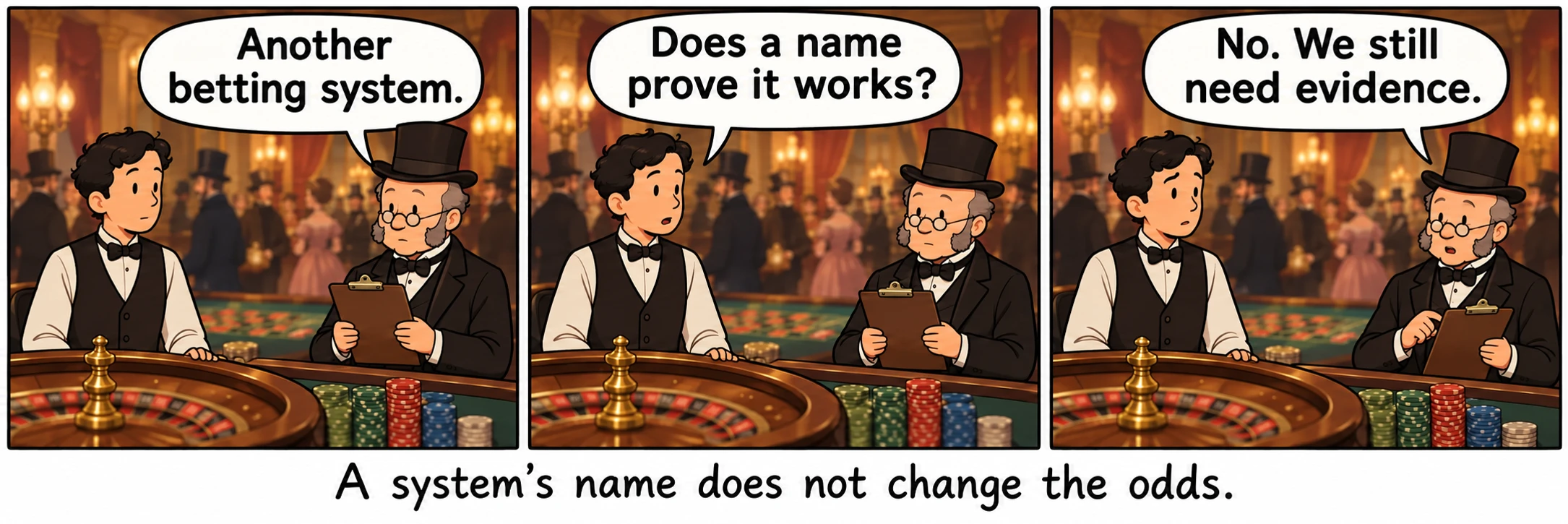
Maḓana a miṅwaha mavhili a madzina. Nomboro nthihi.
Zwiko
- Thorp, E. O. “Optimal gambling systems for favorable games.”
- Thorp, E. O. The Mathematics of Gambling.
- Doob, J. L. “Note on probability.”
- Halmos, P. R. “Invariants of certain stochastic transformations: the mathematical theory of gambling systems.”
- d’Alembert, J. “Croix ou pile.”
- Schwartz, D. G. Roll the Bones: The History of Gambling.
- Kavanagh, T. M. Dice, Cards, Wheels: A Different History of French Culture.
- Bollman, M. Mathematics of the Big Four Casino Table Games: Blackjack, Baccarat, Craps, & Roulette.
- Académie française, martingale, 1762
- Académie française, martingale, 1878