Ndingo ya Chi-Square
Ndingo ya tshiṱandadi ya “zwivhalo izwi zwa 37 ndi zwine vhili ḽi songo kheluwaho ḽa nga zwi bveledza naa?”
χ² = Σ (zwo vhonwaho − zwo lavhelelwaho)² / zwo lavhelelwaho kha mabuli oṱhe a 37. Vhambedzani na phaḓaladzo ya chi-square kha zwiimo zwa mbofholowo zwa 36 uri ni wane ndeme ya p.
U i vhalela
Tshivhalo tshi lavhelelwaho kha bulizwishumiswaBuliḼiṅwe ḽa mabuli a 37 o ṅwalwaho nomboro kha rotara. Ḽi dovha ḽa vhidzwa: slot, cup.Vhalani zwoṱhe → ḽiṅwe na ḽiṅwe ndi n/37. Kha buli ḽiṅwe na ḽiṅwe, andisani phambano vhukati ha zwo vhonwaho na zwo lavhelelwaho nga yone ine, ni kovhe nga zwo lavhelelwaho; ṱanganyani zwipiḓa zwa 37. Vhili ḽi songo kheluwaho ḽi ṋea ndeme dzi re tsini na 36 nga tshivhalo tsha vhukati (zwiimo zwa mbofholowolaborathoriZwiimo zwa mbofholowoTshivhalo tsha ndeme dzi ḓiimisaho kha tshiṱatisiṱiki. Kha ndingo ya chi-square kha mabuli a 37 ndi 36, ngauri zwivhalo zwi fanela u ṱanganela zwa ita tshivhalo tshoṱhe.Vhalani zwoṱhe →), nga phambuwo ya tshiṱandadimathematikiPhambuwo ya tshiṱandadiMudzi wa tshikwea wa vhariantsi; tshikhala tsha ḓuvha ḽiṅwe na ḽiṅwe vhukati ha mvelelo na ndeme yo lavhelelwaho.Vhalani zwoṱhe → ya 8.5. Nṱha ha 51.0 zwi na ndeme kha vhuimo ha 5%; nṱha ha 58.6 kha 1%. Tshisaukanyi tsha U Kheluwa ha Vhili tshi vhalela tshivhalo itsho na ndeme ya plaborathoriNdeme ya pKhonadzeo ya u vhona u kheluwa hu linganaho kana hu fhiraho hune ha vhonwa arali vhili ḽo vha ḽi songo kheluwa.Vhalani zwoṱhe → yo teaho nga fankishini ya gamma i songo fhelelaho yo lugiswaho.
Tsumbo yo shumiwaho
Consider a hypothetical sample of 1,000 independent spinsmathematikiMimono i ḓiimisahoMumono muṅwe na muṅwe u na khonadzeo dzi fanaho hu sa londwi zwo fhiraho. Ndi mutheo wa u vhalela hoṱhe kha saiti ino.Vhalani zwoṱhe →. Each pocket has an expected count of 1,000/37 ≈ 27.03. If pocket 8 appears 41 times, its contribution to the statistic is about 7.22. Suppose the total statistic is approximately 45.2. On 36 degrees of freedom, the approximate p-value is 0.14: under the fair-wheel model, a statistic at least this large has a probabilitymathematikiKhonadzeoKhonadzeo ya mvelelo, u bva kha 0 u ya kha 1 kana 0% u ya kha 100%. Nomboro nthihi: 1/37 = 2.70%.Vhalani zwoṱhe → of about 14%. This is not significant at the 5% level, and it does not prove the wheel is fair. A pocket selected after examining these counts needs independent confirmation; another 1,000 spins is not guaranteed to resolve a small departure.
Zwine zwa dzhiiwa
The usual approximation assumes independent observations and adequate expected counts. The common five-per-cell rule gives n ≥ 185 for 37 equal pockets; it is a guideline for the approximation, not a hard boundary for all possible tests. Pooling wheels changes the population being tested. Dependence may invalidate the reference distribution without necessarily increasing the statistic.
Pearson na Monte Carlo
Karl Pearson o gandisa ndingo nga 1900, nahone iṅwe ya tsumbo dzawe dza u thoma yo vha i mimono ya 26,306 ya rulete ya Monte Carlo yo ṅwaliwaho, ye a i wana i sa lingani nga maanḓa lwa uri i sa vhe ya khonadzeo, a ri “rulete ya Monte Carlo… a si mutambo wa khonadzeo”. Vhaṅwali vha nga murahu vho wana uri vhoraḓiṅwalwa vhe vha ṅwala mimono iyo kha gurannda vho ṱumbula minzhi yayo, zwine zwa vha ngudo nga yoṱhe nga ha uri data i bva ngafhi.

Ndingo ya vhukuma: mavhili a ḓishumaho ngei Las Vegas
A published analysis of specific automatic wheels is evidence about those recorded samples, not all automatic roulette. A non-significant uniformity test cannot prove the absence of steering, and combining several wheels does not identify the behavior of each one. Check the original study’s data and design before drawing that conclusion.
Nṱha ha chi-square
Kha buli ḽithihi ḽi timatimiswaho, ndingo ya bainomiala i na maanḓa u fhira. Kha tshipiḓa tshi timatimiswaho, ndingo ya z ya tshipiḓavhiliTshipiḓaMabuli a tevhekanaho kha vhili, a ita tshipiḓa tsha tshiṱuluwa, zwi fhambanaho na tshigwada kha mapa wa tafula.Vhalani zwoṱhe → kha siaṱari ḽa Tsenguluso ya zwipiḓa. Chi-square ndi ndingo ya zwoṱhe: i ni vhudza uri hu na tshi songo lugaho i sa ambi uri ndi mini. I shumiseni u thoma, nga murahu ni sedze.
Fomula
Mbudziso
Zwivhalo zwa 37 zwi fanela u ṱanganyiwa zwa vha n, ngauralo ndi zwa 36 fhedzi zwi re na mbofholowo ya u shanduka.
Vhili ḽi re na buli ḽithihi ḽa 1/25 kha mimono ya 10,000 ḽi nga ṋea tshipiḓa tsha buli tshi re tsini na 60 tshoṱhe; χ² i tsini na 100, p i tsini na ziro nga vhukuma.
Nga thekhiniki ee, hu tshi lavhelelwa 5.4 kha buli ḽiṅwe na ḽiṅwe. A i nga wani tshithu, nga nnḓa ha vhili ḽi re na buli ḽo valwaho nga gulu.
Zwa u sea
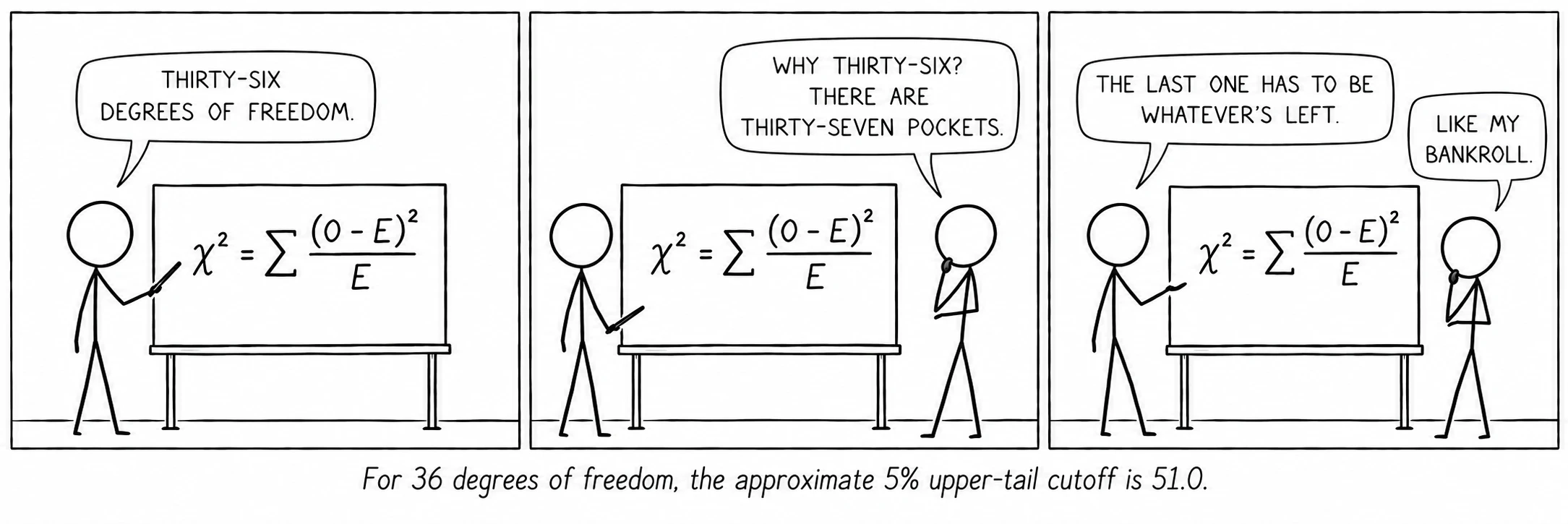
For 36 degrees of freedom, the approximate 5% upper-tail cutoff is 51.0.
Zwiko
- Pearson, K. “On the criterion that a given system of deviations from the probable…”
- Feller, W. An Introduction to Probability Theory and Its Applications, Vol. 1.