Ndila ya Kelly na Rulete
Nḓila ya Kelly i vhudza muthu a vheaho bete a re na mbuelo uri a vhee tshelede ingana. Kha rulete i ṋea phindulo i pfalaho: a hu na tshelede.

Tshelede ya bete ya Kelly = mbuelo / tshikalo. Musi mbuelo i fhasi ha ziro, fomula i ṋea tshipiḓa tshi re fhasi ha ziro, zwine zwa amba uri ni songo vhea bete. Nḓila iyi i kha ḓi thusa u pfesesa uri ndi ngani vhatambi vha vhili ḽo kheluwaho vho vhea dzibete nga saizi ye vha vhea ngayo, na uri ndi ngani vhaṅwe vhoṱhe vha tshi fanela u vhea nga bajete.
Nḓila
John Kelly (1956) asked how a gambler with a known edge should size bets to maximize long-run growth of the bankrolltsheledeTshelede ya u tambaTshelede yoṱhe yo vhewaho thungo u itela u tamba. Ndangulo ya tshelede ya u tamba ndi u dzhia tsheo ya uri ni ḓo khakhisa nngafhani kha bete iṅwe na iṅwe na kha seshini iṅwe na iṅwe.Vhalani zwoṱhe →. The answer, for a bet paying b to 1 with win probabilitymathematikiKhonadzeoKhonadzeo ya mvelelo, u bva kha 0 u ya kha 1 kana 0% u ya kha 100%. Nomboro nthihi: 1/37 = 2.70%.Vhalani zwoṱhe → p and loss probability q = 1 − p, is to stake the fraction f* = (bp − q) / b of the bankroll. Positive f* means bet that fraction; zero or negative means do not bet. Kelly worked at Bell Labs, and his paper, “A new interpretation of information rate”, set the problem in Claude Shannon’s theory of information: a gambler who gets tips over a noisy line, at fair odds, can grow the bankroll at best at the rate the line carries information. This is a growth objective under a probability model, not a promise to finish ahead after a particular number of bets. A spending limit, finite deadline or payouttsheledeMbadeloZwine bete yo kundaho ya humisa, zwi tshi ambiwa sa “X kha 1” nṱha ha tshelede ya bete i humiswaho.Vhalani zwoṱhe → cap changes the decision problem.

U vhea bete nga nḓila ya Kelly kha rulete
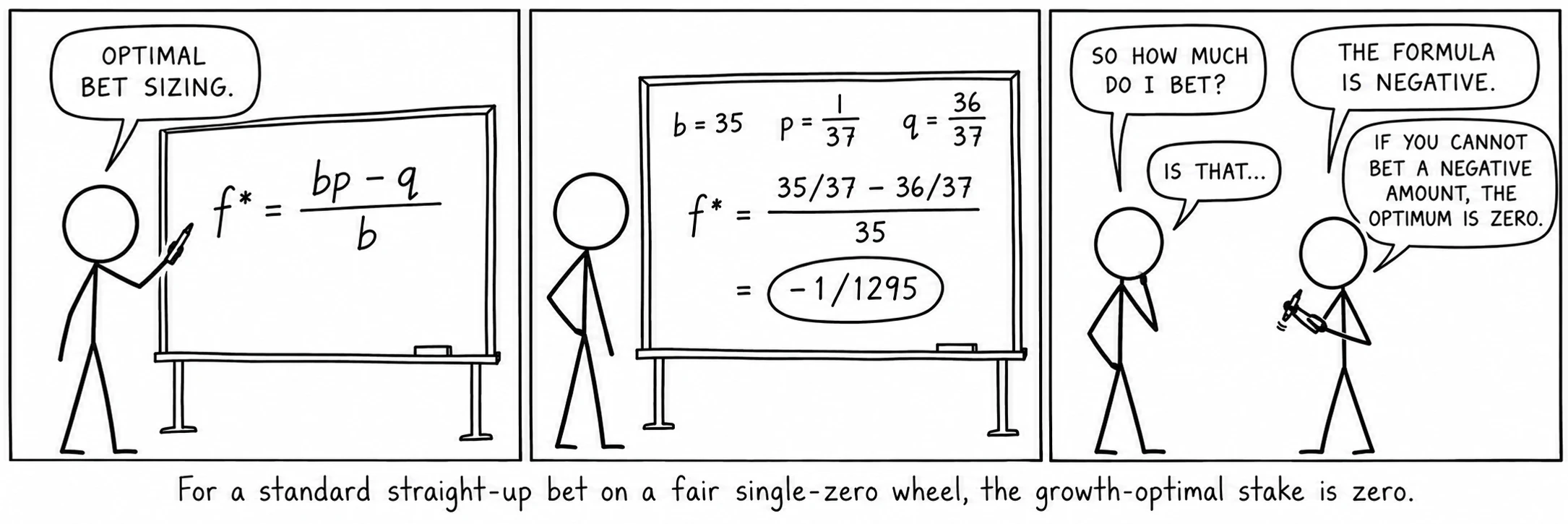
For redbeteTswukuBete ya tshelede i linganaho kha nomboro dza 18 tswuku. Nga Lufurantsi: rouge.Vhalani zwoṱhe →: b = 1, p = 18/37, q = 19/37; f* = (18/37 − 19/37)/1 = −1/37. For a straight upbeteNomboro nthihiNomboro nthihi, i badela 35:1.Vhalani zwoṱhe →: b = 35, p = 1/37, q = 36/37; f* = (35/37 − 36/37)/35 = −1/1295. Every standard bet gives a negative Kelly fraction, because every bet has a negative edge, and the growth-optimal stake is zero. Kelly betting on roulette is a formal way of saying what the house-edge page says: no positive stake maximizes expected logarithmic growth when the bet has negative expectation. A particular session can still end in profit. La partagemulayoLa partageMulayo wa Furantsi: musi ziro i tshi bva, hafu ya tshelede ya bete ya tshelede i linganaho i a humiswa. U fhungudza mbuelo ya khasino kha dzeneedzo dzibete nga hafu u swika kha 1.35%.Vhalani zwoṱhe → needs a separate three-outcome calculation: a win, a full loss or a half-loss on zerovhiliZiroBuli ḽithihi ḽa muvhala wa tala ḽine ḽa sa farwe nga bete ya tshelede i linganaho, ya dazini kana ya kholomu; ndi tshisima tsha mbuelo ya khasino. Ḽi dovha ḽa vhidzwa: ziro nthihi, 0.Vhalani zwoṱhe →. Its expected log growth also falls as the stake increases from zero.
Hune Kelly ya shuma hone
Suppose a pocketzwishumiswaBuliḼiṅwe ḽa mabuli a 37 o ṅwalwaho nomboro kha rotara. Ḽi dovha ḽa vhidzwa: slot, cup.Vhalani zwoṱhe → really has a stable, known probability of 1 in 30 and pays 35 to 1. The Kelly fraction is 0.57%: about $57 from a $10,000 bankroll. Under independent spinsmathematikiMimono i ḓiimisahoMumono muṅwe na muṅwe u na khonadzeo dzi fanaho hu sa londwi zwo fhiraho. Ndi mutheo wa u vhalela hoṱhe kha saiti ino.Vhalani zwoṱhe → and exact fractional staking, the geometric growth factor over 1,000 spins is about 1.7. Expected bankroll grows faster because rare large wins pull up the average. These are model calculations, not evidence that any named historical player used Kelly or achieved this result.
I ḓoweleaho na ya tshivhalo tsha vhukati
The gap between the typical bankroll and the average one is wide. Take a pocket that hits 1 time in 25, a hypothetical edge of 44% per unittsheledeYunitiTshelede ya bete ya mutheo ine sisiṱeme kana mutambi a shuma ngayo. Nyengedzo dza bete dzi ṱalutshedzwa nga dziyuniti uri dzi shume kha tafula iṅwe na iṅwe.Vhalani zwoṱhe → staked. Kelly stakes 1.26% of the bankroll on it. After 1,000 spins the typical bankroll has grown about 11.5 times, while the average, pulled up by a few very lucky runs, has grown about 249 times. Betting more than Kelly raises the average and lowers the typical result: at twice the Kelly stake the typical bankroll only doubles, and by two and a half times the Kelly stake it shrinks, although every bet still carries a 44% edge. In this example, half-Kelly retains about 78% of the expected log growth. This fraction depends on the probabilities and payout.
Musi mbuelo i tshi anganyelwa fhedzi
Kelly uses the true probabilities, but a player usually has only estimates. Selecting the busiest pocket from a past record creates a selection problem: even a fair wheel has a busiest pocket. Its observed rate can overstate its future probability. Choosing the stake from that same record compounds the error. An independent follow-up sample helps test a proposed bias (see How to Detect Roulette Wheel Bias). Reducing the calculated fraction reduces exposure, but cannot turn a false edge into a real one.
Vhathu vha re na mbuelo
Haghani and Dewey (2016) studied 61 participants given $25 and 30 minutes to bet on a simulated coin with a disclosed 60% chance of heads. The payout cap was $250; its value was revealed when a proposed winning bet would reach it. Their reported 21% success category included balances of at least $200, while the 28% “bust” category meant less than $2, not necessarily zero. Eighteen participants bet their entire balance on one flip. The uncapped Kelly fraction is 20%, but the cap and deadline change the optimization problem. The experiment illustrates how stake choices matter even with a known advantage; it does not establish one best strategy for every objective.
Zwine na nga shumisa nṱhani hazwo
Musi hu si na mbuelo, saizi ya bete ndi mbudziso ya bajete, hu si ya nyaluwo: tshelede ya bete = zwine na tenda u zwi shumisa nga mumono, zwo wanalaho kha bajete ya awara na tshimbilo ya tafula (siaṱari ḽa ndangulo ya tshelede ya u tamba). Zwine Kelly a zwi ṋea mutambi wa ḓuvha na ḓuvha ndi u pfala ha phindulo yawe: ziro. Tshelede iṅwe na iṅwe ine na i vhea nṱha ha ziro ndi mutengo wa u tamba, wo khethwaho nga inwi, hu si wo khwiṋiswaho nga fomula iṅwe na iṅwe.
Mafhungo nga ha tshipiḓa tsha Kelly na “ndangulo ya tshelede”
Betting a fixed percentage of the current bankroll is proportional staking: the stake rises after wins and falls after losses. Flat bettingtshiṱirathedzhiBete i sa shandukiU vhea tshelede i fanaho kha mumono muṅwe na muṅwe. Ndi mutheo une nyengedzo iṅwe na iṅwe ya bete ya vhambedzwa nawo.Vhalani zwoṱhe → instead keeps the cash stake fixed. Neither creates an edge on ordinary roulette. With infinitely divisible stakes and a fraction below 100%, proportional staking never reaches exactly zero in finitely many losses, but the balance can become arbitrarily small. Real table minimums can prevent further play much sooner. The growth-optimal fraction remains zero.
Fomula
Mbudziso
Only when the actual probabilities, payouts and conditions give a credible positive advantage. Standard bets on an unbiased wheel have no such advantage.
Using half the calculated fraction reduces exposure to errors in the estimated edge. The familiar three-quarters-growth rule is an approximation for small advantages, not a universal identity. It does not protect against an edge that does not exist.
Hai. Kelly i khwiṋisa nyaluwo musi hu na mbuelo. Ndangulo ya tshelede ya u tamba i langa u shumiswa ha tshelede musi hu si na mbuelo.
Mathematiki ya u ḓiphina
Lingedzani hedzi nga inwi vhaṋe u thoma. Phindulo iṅwe na iṅwe yo dzumbiwa; i voreni musi no no ḓilugisa.
Suppose a hypothetical bet on one number has a known 44% edge under standard payoutstsheledeMbadeloZwine bete yo kundaho ya humisa, zwi tshi ambiwa sa “X kha 1” nṱha ha tshelede ya bete i humiswaho.Vhalani zwoṱhe → and independent spinsmathematikiMimono i ḓiimisahoMumono muṅwe na muṅwe u na khonadzeo dzi fanaho hu sa londwi zwo fhiraho. Ndi mutheo wa u vhalela hoṱhe kha saiti ino.Vhalani zwoṱhe →. Kelly gives a 1.26% bankrolltsheledeTshelede ya u tambaTshelede yoṱhe yo vhewaho thungo u itela u tamba. Ndangulo ya tshelede ya u tamba ndi u dzhia tsheo ya uri ni ḓo khakhisa nngafhani kha bete iṅwe na iṅwe na kha seshini iṅwe na iṅwe.Vhalani zwoṱhe → fraction. What if the same 44% edge came on one bet spread over five neighboring numbers?
Sumbedzani phindulo
Phindulo Nga henefho nḓila ya Kelly i ri 7.1% ya tshelede ya u tamba, nahone tshelede ya u tamba i aluwa lwa u ṱoḓa u vha rathi nga u ṱavhanya: hu ṱoḓa u vha lwa milioni dza 1.25 kha dzibete dza 1,000, u fhambana na lwa 11.5.
A straight upbeteNomboro nthihiNomboro nthihi, i badela 35:1.Vhalani zwoṱhe → with a 44% edge wins with chance 0.04, since 36 × 0.04 = 1.44. Kelly’s stake is the edge divided by the odds: 0.44/35 = 1.26%. The typical growth per bet is 0.04 × ln(1 + 35 × 0.0126) + 0.96 × ln(1 − 0.0126) ≈ 0.00244, so 1,000 bets multiply the bankroll by about e^2.44 ≈ 11.5.
Spread one stake over five numbers and the bet wins with chance 0.20 and pays 36/5 for 1, that is 6.2 to 1: still a 44% edge, since 0.2 × 7.2 = 1.44. Kelly’s stake becomes 0.44/6.2 = 7.10%, and the growth per bet 0.01404, about 5.75 times as much. Over 1,000 bets that is e^14.04, about 1.25 million.
The edge is the same; the swings are smaller. A bet that wins one time in five has a larger growth-optimal fraction in this model, although losses can still reduce the bankroll severely. This comparison assumes the same known edge for both bets; actual predictions need independent evidence.
Assume two numbers are adjacent on the betting layoutzwishumiswaMapa wa tafulaGiridi ya bete yo gandiswaho kha tafula. U dovha wa vhidzwa: tafula, felt, cloth.Vhalani zwoṱhe → and each has a stable, known probabilitymathematikiKhonadzeoKhonadzeo ya mvelelo, u bva kha 0 u ya kha 1 kana 0% u ya kha 100%. Nomboro nthihi: 1/37 = 2.70%.Vhalani zwoṱhe → of 1 in 25 on independent spins. Compare a splitbeteNomboro mbiliNomboro mbili dzi re tsini, i badela 17:1.Vhalani zwoṱhe → between them at 17 to 1 with equal straight-up stakes on the two numbers. How much does Kelly say, and how fast does the bankroll grow compared with one such pocketzwishumiswaBuliḼiṅwe ḽa mabuli a 37 o ṅwalwaho nomboro kha rotara. Ḽi dovha ḽa vhidzwa: slot, cup.Vhalani zwoṱhe →?
Sumbedzani phindulo
Phindulo A zwi shandukisi tshithu: 2.59% ya tshelede ya u tamba kha bete ya nomboro mbili, kana 1.29% kha nomboro iṅwe na iṅwe. Tshelede ya u tamba yo ḓoweleaho i aluwa lwa 155 kha mimono ya 1,000, u fhambana na lwa 11.5 nga buli ḽithihi.
The split wins with probability 2/25 = 0.08 and pays 17 to 1, so it returns 18 × 0.08 = 1.44 per unittsheledeYunitiTshelede ya bete ya mutheo ine sisiṱeme kana mutambi a shuma ngayo. Nyengedzo dza bete dzi ṱalutshedzwa nga dziyuniti uri dzi shume kha tafula iṅwe na iṅwe.Vhalani zwoṱhe → staked: an edge of 44%, the same as one biased pocket. Kelly’s stake is the edge divided by the odds: 0.44/17 = 2.59%.
Two straight-up bets of 1.29% each give exactly the same results. When either number comes up, one chiptsheledeTshipisiTshiga tshine tsha imela tshelede yo tiwaho, tshi vhewaho kha mapa wa tafula u vhea bete. Tshi dovha tsha vhidzwa: check.Vhalani zwoṱhe → wins 35 to 1 and the other is lost, a net of 34 × 1.29% = 44% of the bankroll, as the split pays; when neither does, both are lost.
The growth per spin is 0.00505, against 0.00244 for one pocket, so over 1,000 spins the typical bankroll grows e^5.046 ≈ 155 times rather than e^2.44 ≈ 11.5 times. The geometric growth factor is larger because the combined bet wins more often at the same 44% edge. It is a model result, not a guaranteed bankroll.
Zwa u sea
Tshelede ya bete ya rulete ine ya aluwisa nga maanḓa ndi nomboro ine muṅwe na muṅwe a i ḓivha.
Zwiko
- Kelly, J. L. “A new interpretation of information rate.”
- Breiman, L. “Optimal gambling systems for favorable games.”
- Thorp, E. O. “Optimal gambling systems for favorable games.”
- Thorp, E. O. The Mathematics of Gambling.
- Epstein, R. A. The Theory of Gambling and Statistical Logic, 2nd ed.
- Taylor, D. G. Games, Gambling, and Probability: An Introduction to Mathematics, 2nd ed.
- Ethier, S. N. The Doctrine of Chances: Probabilistic Aspects of Gambling.
- Haghani, V. & Dewey, R. “Rational decision-making under uncertainty: observed betting patterns on a biased coin.”